MCQ
The presently accepted value of charge/ mass (e/ m) is:
- A1.66 × 10–19c/ kg.
- B9.1 × 1011c/ kg.
- C1.76 × 1011c/ kg.
- D9.1 × 1019c/ kg.
Generate a complete, print-ready paper with questions like this in minutes — across 16+ boards, with answer keys.
A wire carrying current i is shaped as shown. Section AB is a quarter circle of radius r. The magnetic field is directed
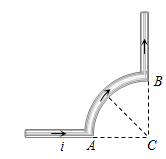
|
(a) At an angle π/4 to the plane of the paper |
|
(b) Perpendicular to the plane of the paper and directed in to the paper |
|
(c) Along the bisector of the angle ACB towards AB |
|
(d) Along the bisector of the angle ACB away from AB |
The binding energy of nucleus is a measure of its
| (a) Charge | (b) Mass | (c) Momentum | (d) Stability |
Work function of lithium and copper are respectively 2.3 eV and 4.0 eV. Which one of the metal will be useful for the photoelectric cell working with visible light ? (h = 6.6 × 10⁻³⁴ J-s, c = 3 × 10⁸ m/s)
|
(a) Lithium |
(b) Copper |
(c) Both |
(d) None of these |
The maximum number of possible interference maxima for slit-separation equal to twice the wavelength in Young’s double-slit experiment is
|
(a) Infinite |
(b) Five |
(c) Three |
(d) Zero |