MCQ
The pressure applied from all directions on a cube is $P$. How much its temperature should be raised to maintain the original volume $?$ The volume elasticity of the cube is $\beta $ and the coefficient of volume expansion is $\alpha $
  • $\frac{P}{{\alpha \beta }}$
  • B
    $\frac{{P\alpha }}{\beta }$
  • C
    $\frac{{P\beta }}{\alpha }$
  • D
    $\frac{{\alpha \beta }}{P}$

Answer

Correct option: A.
$\frac{P}{{\alpha \beta }}$
a
(a) If coefficient of volume expansion is $\alpha $ and rise in temperature is $\Delta \theta $ then $\Delta V = V\alpha \Delta \theta $$\Rightarrow $ $\frac{{\Delta V}}{V} = \alpha \Delta \theta $

Volume elasticity $\beta = \frac{P}{{\Delta V/V}}$ $ = \frac{P}{{\alpha \Delta \theta }}$==> $\Delta \theta = \frac{P}{{\alpha \beta }}$

Need a full question paper?

Generate a complete, print-ready paper with questions like this in minutes — across 16+ boards, with answer keys.

Start Generating Free

Similar questions

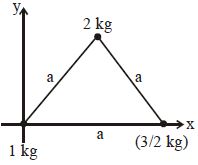
Three particles of masses $1\,kg,\,\frac {3}{2}\,kg$ , and $2\,kg$ are located at the vertices of an equilateral triangle of side $a$ . The $x, y$ coordinates of the centre of mass are
The extension in a string obeying Hooke's law is $x.$ The speed of sound in the stretched string is $v.$ If the extension in the string is increased to $1.5x$, the speed of sound will be
A river is flowing from west to east at a speed of $8\,m$ per min. A man on the south bank of the river, capable of swimming at $20\,m / min$ in still water, wants to swim across the river in the shortest time. He should swim in a direction
Intensity level of a sound of intensity $I$ is $30\, dB$. The ratio $\frac{I}{{{I_0}}}$ is (Where ${I_0}$ is the threshold of hearing)
A particle of mass $m$ is moving in a straight line with momentum $p$. Starting at time $t = 0$, a force $F = kt$ acts in the same direction on the moving particle during time interval $T$ so that its momentum changes from $p$ to $3p$. Here $k$ is a constant. The value of $T$ is
At whose name did India launch the first statellie?
Let $\left| {{{\vec A}_1}} \right| = 3,\,\left| {\vec A_2} \right| = 5$, and $\left| {{{\vec A}_1} + {{\vec A}_2}} \right| = 5$. The value of $\left( {2{{\vec A}_1} + 3{{\vec A}_2}} \right)\cdot \left( {3{{\vec A}_1} - 2{{\vec A}_2}} \right)$ is
A cubic vessel (with face horizontal + vertical) contains an ideal gas at NTP. The vessel is being carried by a rocket which is moving at a speed of 500ms-1 in vertical direction. The pressure of the gas inside the vessel as observed by us on the ground:
  1. Remains the same because 500ms-1 is very much smaller than vrms of the gas.
  2. Remains the same because motion of the vessel as a whole does not affect the relative motion of the gas molecules and the walls.
  3. Will increase by a factor equal to (v2rms + (500)2)/ v2rms where vrms was the original mean square velocity of the gas.
  4. Will be different on the top wall and bottom wall of the vessel.
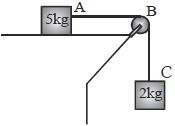
A trolley of mass $5\,kg$ on a horizontal smooth surface is pulled by a load of mass $2\,kg$ by means of uniform rope $ABC$ of length $2\,m$ and mass $ 1\,kg.$ As the load falls from $BC = 0$ to $BC = 2\,m,$ its acceleration in $m/s^2$ changes from