Question
The pressure of the wheel of motor car at any instant is equal to 2 atmospheric pressure at the temperature is $15^{\circ} C$. At this moment the tube of the wheel bursts. Find the decrease in temperature of the released $\operatorname{air}(\gamma=1.4)$
Answer

Given that :
$P_1=2 Atmospheric$
$\begin{aligned}T_1 & =15^{\circ} C=15+273=288 K \\\gamma & =1.4 \\T_2 & =? \\P_2 & =1 \text { Atmospheric }\end{aligned}$
And
We know that
\begin{array}{l} 
P_1^{1-\gamma} T_1^\gamma=P_2^{1-\gamma} T_2^\gamma=\text { Constant } \\\begin{aligned}\left(\frac{P_1}{P_2}\right)^{1-\gamma} & =\left(\frac{T_2}{T_1}\right)^\gamma \\\left(\frac{T_2}{T_1}\right)^\gamma & =\left(\frac{P_2}{P_1}\right)^{\frac{\gamma-1}{\gamma}} \\T_2 & =T_1\left(\frac{P_2}{P_1}\right)^{\frac{\gamma-1}{\gamma}} \\& =288\left(\frac{1}{2}\right)^{\frac{1.4-1}{1.4}} \\& =288\left(\frac{1}{2}\right)^{2 / 7} \\
T_2 & =\frac{280}{2^{2 / 7}}\end{aligned}\end{array}
Taking log both sides :
$\begin{aligned}\log T_2 & =\log 288-\frac{2}{7}\log 2 \\& =2.4594-\frac{2}{7}(0.3010) \\& =2.4594-0.086\\\log T_2 & =2.3734 \\ T_2 & =\text { Anti } \log 2.3734\\\therefore\quad T_2 & =236.3 K\end{aligned}$
Decrease in temperature
$\begin{array}{l}=288-236.3 \\=51.7 K\end{array}$

Need a full question paper?

Generate a complete, print-ready paper with questions like this in minutes — across 16+ boards, with answer keys.

Start Generating Free

Similar questions

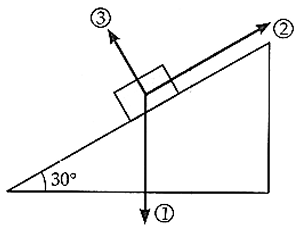
A block of wood of mass 3 kg is resting on the surface of a rough inclined surface, inclined at an angle $\theta$ as shown in the figure.
Image
a. Name the forces $(1,2,3)$.
b. If the coefficient of static friction is 0.2 , calculate the value of all three forces.
$
\text { (use } g=10 m / s^2 \text { ) }
$
The magnetic intensity Hat the centre of a long solenoid carrying a current of 2.0A, is found to be 1500A/m. Find the number of turns per centimetre of the solenoid.
What is Graham's law of gas diffusion ? Propound this law on the basis of molecular motion theory.
Two bodies make an elastic head-on collision on a smooth horizontal table kept in a car. Do you expect a change in the result if the car is accelerated on a horizontal road because of the noninertial character of the frame? Does the equation "Velocity of separation = Velocity of approach" remain valid in an accelerating car? Does the equation "Final momentum = Initial momentum" remain valid in the accelerating car?
Precise measurements of physical quantities are a need of science. For example, to ascertain the speed of an aircraft, one must have an accurate method to find its positions at closely separated instants of time. This was the actual motivation behind the discovery of radar in World War II. Think of different examples in modern science where precise measurements of length, time, mass etc. are needed. Also, wherever you can, give a quantitative idea of the precision needed.
Two perfect gases at absolute temperatures $T_1$ and $T_2$ are mixed. There is no loss of energy. Find the temperature of the mixture if the masses of the molecules are $m_1$ and $m_2$ and the number of the molecules in the gases are $n_1$ and $n_2$ respectively.
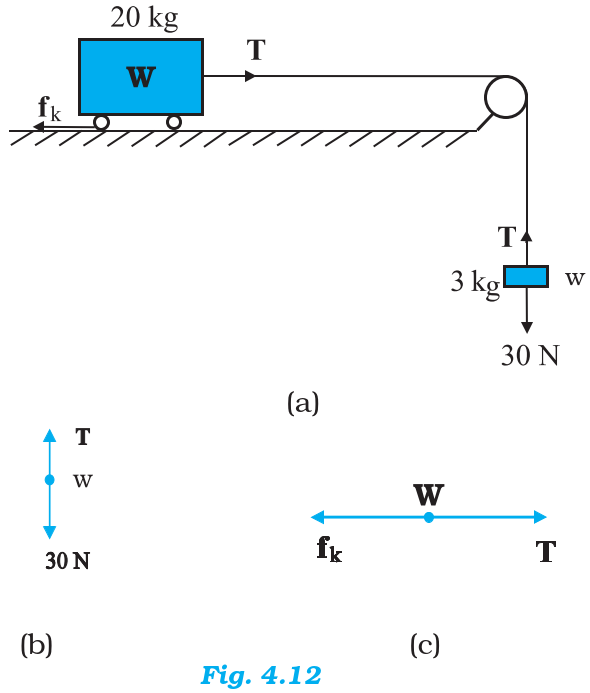
What is the acceleration of the block and trolley system shown in a Fig. 4.12(a), if the coefficient of kinetic friction between the trolley and the surface is 0.04 ? What is the tension in the string? (Take $g=$ $10 m s ^{-2}$ ). Neglect the mass of the string.
Image
A tightly-wound, long solenoid carries a current of 2.00A. An electron is found to execute a uniform circular motion inside the solenoid with a frequency of $1.00 \times 10^8 rev/s$. Find the number of turns per metre in the solenoid.
What is the need for banking of road? Write the expression for the maximum speed with which a vehicle can safely negotiate a curved road banked at an angle $\theta.$ The coefficient of friction between the wheels and the road is $\mu.$
The acceleration experienced by a boat, after its engine is cut off, given by, $\frac{\text{dv}}{\text{dt}}=-\text{kv}^3,$ where k is a constant. If $v_0$ is the magnitude of velocity at cut off $(t = 0)$, find the magnitude of the velocity at a time t after the cut off.