MCQ
The pressure wave, $P = 0.01\,sin\,[1000t -3x]\,Nm^{-2},$ corresponds to the sound produced by a vibrating blade on a day when atmospheric temperature is $0\,^oC.$ On some other day when temperature is $T,$ the speed of sound produced by the same blade and at the same frequency is found to be $336 \,ms^{-1}$. Approximate value of $T$ is .... $^oC$
  • A
    $12$
  • B
    $11$
  • C
    $15$
  • $4$

Answer

Correct option: D.
$4$
d
Speed of wave from wave equation

$v=-\frac{(\text { coeffecient of } t)}{(\text { coeffecient of } x)}$

$v=-\frac{1000}{(-3)}=\frac{1000}{3}$

since speed of wave $\propto \sqrt{T}$

$\mathrm{So}=\frac{1000}{\frac{3}{336}}=\sqrt{\frac{273}{\mathrm{T}}}$

$\Rightarrow T=277.41 \mathrm{K}$

$\mathrm{T}=4.41^{\circ} \mathrm{C}$

Need a full question paper?

Generate a complete, print-ready paper with questions like this in minutes — across 16+ boards, with answer keys.

Start Generating Free

Similar questions

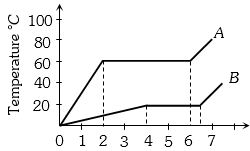
Two substances $A$ and $B$ of equal mass m are heated at uniform rate of $6\, cal s^{-1}$ under similar conditions. $A$ graph between temperature and time is shown in figure. Ratio of heat absorbed ${H_A}/{H_B}$ by them for complete fusion is
Which of the following doesn't represent rotatory motion?
A man can hear sounds in frequency range $120\,Hz$ to $12020\,Hz$. only. He is vibrating a piano string having a tension of $240\,N$ and mass of $3\,gm$ . The string has a length of $8\,m$ . How many different frequencies can he hear ?
Consider the following two statements.
$A.$ If heat is added to a system, its temperature must increase.
$B.$ If positive work is done by a system in a thermodynamic process, its volume must increase.
Consider a long, straight wire of cross-sectional area A carrying a current i. Let there be n free electrons per unit volume. An observer places himself on a trolley moving in the direction opposite to the current with a speed $\text{v}=\frac{\text{i}}{\text{nAe}}$ and separated from the wire by a distance r. The magnetic field seen by the observer is very nearly:
A body of density $\rho'$  is dropped from rest at a height $h$ into a lake of density $\rho$ , where $\rho > \rho '$ . Neglecting all dissipative forces, calculate the maximum depth to which the body sinks before returning to float on the surface.
$10\; amu =$ ……..$kg$
A sample of gas at temperature $\mathrm{T}$ is adiabatically expanded to double its volume. Adiabatic constant for the gas is $\gamma=3 / 2$. The work done by the gas in the process is : $(\mu=1 \mathrm{~mole})$
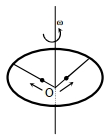
A ring of mass $M$ and radius $R$ is rotating with angular speed $\omega$ about a fixed vertical axis passing through its centre $O$ with two point masses each of mass $\frac{ M }{8}$ at rest at $O$. These masses can move radially outwards along two massless rods fixed on the ring as shown in the figure. At some instant the angular speed of the system is $\frac{8}{9} \omega$ and one of the masses is at a distance of $\frac{3}{5} R$ from $O$. At this instant the distance of the other mass from $O$ is
Consider a vector $\overrightarrow F = 4\hat i - 3\hat j.$ Another vector that is perpendicular to $\overrightarrow F $ is