MCQ
The probability of solving a question by three students are $\frac{1}{2},\,\,\frac{1}{4},\,\,\frac{1}{6}$ respectively. Probability of question is being solved will be
  • $\frac{{33}}{{48}}$
  • B
    $\frac{{35}}{{48}}$
  • C
    $\frac{{31}}{{48}}$
  • D
    $\frac{{37}}{{48}}$

Answer

Correct option: A.
$\frac{{33}}{{48}}$
a
(a) $(i)$ This question can also be solved by one student

$(ii)$ This question can be solved by two students simultaneously

$(iii)$ This question can be solved by three students all together.

$P(A) = \frac{1}{2},\,\,P(B) = \frac{1}{4},\,P(C) = \frac{1}{6}$

$P(A \cup B \cup C) = $ $P(A)\, + P(B) + P(C)$

$ - [P(A).\,P(B) + P(B)\,.\,P(C) + \,P(C)\,.\,P(A)] + [P(A).P(B).P(C)]$

$ = \frac{1}{2} + \frac{1}{4} + \frac{1}{6} - \left[ {\frac{1}{2} \times \frac{1}{4} + \frac{1}{4} \times \frac{1}{6} + \frac{1}{6} \times \frac{1}{2}} \right] + \left[ {\frac{1}{2} \times \frac{1}{4} \times \frac{1}{6}} \right] = \frac{{33}}{{48}}$.

Alliter : $P(A \cup B \cup C) = 1 - P(\bar A)P(\bar B)P(\bar C)$

$ = 1 - \left( {1 - \frac{1}{2}} \right)\,\left( {1 - \frac{1}{4}} \right)\,\left( {1 - \frac{1}{6}} \right)$

$ = 1 - \frac{1}{2}.\frac{3}{4}.\frac{5}{6} = \frac{{33}}{{48}}$.
Need a full question paper?

Generate a complete, print-ready paper with questions like this in minutes — across 16+ boards, with answer keys.

Start Generating Free

Similar questions

Let the sum of the focal distances of the point $P (4,3)$ on the hyperbola $H : \frac{ x ^2}{ a ^2}-\frac{ y ^2}{b^2}=1$ be $8 \sqrt{\frac{5}{3}}$. If for H, the length of the latus rectum is $l$ and the product of the focal distances of the point P is m , then $9 l^2+6 m$ is equal to :-
If $|z_1| = 2 , |z_2| =3 , |z_3| = 4$ and $|2z_1 +3z_2 +4z_3| =9$ ,then value of $|8z_2z_3 +27z_3z_1 +64z_1z_2|$ is equal to:-
If a function $f(x)$ defined by $f(x)=\left\{\begin{array}{ll}a e^{x}+b e^{-x}, & -1 \leq x<1 \\ c x^{2}, & 1 \leq x \leq 3 \\ a x^{2}+2 c x, & 3 < x \leq 4\end{array}\right.$

be continuous for some $a, b, c \in R$ and $f ^{\prime}(0)+ f ^{\prime}(2)= e ,$ then the value of of $a$ is 

$\int_0^2 {\frac{{{x^3}\,dx}}{{{{({x^2} + 1)}^{\frac{3}{2}}}}}} = $
Let  $\tan (2\pi \left| {\sin \,\theta } \right|) = \cot (2\pi \left| {\cos \,\theta } \right|),$ where  $\theta  \in R$ and  $f(x) = (\left| {\sin \,\theta } \right| + \left| {\cos \,\theta } \right|).$ The value of  $\mathop {\lim }\limits_{x \to \infty } \left[ {\frac{2}{{f(x)}}} \right]$ equals (Here $[\,]$ represents greatest integer function)
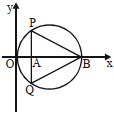
In the circle given below, let $OA =1$ unit, $OB =13$ unit and $PQ \perp OB$. Then, the area of the triangle $PQB$ (in square units) is
Derivative of the function $f(x) = {\log _5}({\log _7}x)$, $x > 7$ is
If ${x^3} + 8xy + {y^3} = 64$, then ${{dy} \over {dx}} = $
For the lines $2x + 5y = 7$and $2x - 5y = 9,$which of the following statement is true
$\tan 3A - \tan 2A - \tan A = $