MCQ
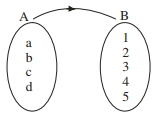
The probability that a randomly chosen one-one function from the set $\{a, b, c, d\}$ to the set $\{1,2,3,4,5\}$ satisfies $f(a)+2 f(b)-f(c)=f(d)$ is
  • A
    $\frac{1}{24}$
  • B
    $\frac{1}{40}$
  • C
    $\frac{1}{30}$
  • $\frac{1}{20}$

Answer

Correct option: D.
$\frac{1}{20}$
d
$n ( s )=5_{ c _{4}} \times 4 !=120$ 

$f ( a )$       + $2 f(b)$        = $f ( c )$       + $f ( d )$
$5$ $2 \times 1$ $4$ $4$
$4$ $2 \times 2$ $3$ $5$
$1$ $2 \times 3$ $2$ $5$

$n ( A )=2 \times 3=6$

$\therefore P ( A )=\frac{ n ( A )}{ n ( s )}=\frac{6}{120}=\frac{1}{20}$
Need a full question paper?

Generate a complete, print-ready paper with questions like this in minutes — across 16+ boards, with answer keys.

Start Generating Free

Similar questions

If X is a binomial variate with parameters n and p, where 0 < p < 1 such that $\frac{\text{P(X = r)}}{\text{P(X = n - r})}$ is independent of n and r, then p equals:
If $A=\left[\begin{array}{cc}2 & 3 \\ 5 & -2\end{array}\right]$, then adj $A$ is equal to
$f(x) = \left\{ \begin{array}{l}
2 - \left| {{x^2} + 5x + 6} \right|,\,\,\,x \ne  - 2\\
{a^2} + 1,\,\,\,\,\,\,\,\,\,\,\,\,\,\,\,\,\,\,\,\,\,\,\,\,x =  - 2
\end{array} \right.$ . Then the range of $a$ , so that $f(x)$ has maximum at $x = -2$, is
Let $\vec{a}=\hat{i}+2 \hat{j}+3 \hat{k}, \quad \vec{b}=2 \hat{i}+3 \hat{j}-5 \hat{k} \quad$ and $\overrightarrow{\mathrm{c}}=3 \hat{\mathrm{i}}-\hat{\mathrm{j}}+\lambda \hat{\mathrm{k}}$ be three vectors. Let $\overrightarrow{\mathrm{r}}$ be a unit vector along $\vec{b}+\vec{c}$. If $\vec{r} . \vec{a}=3$, then $3 \lambda$ is equal to :
If the function f(x) = 2x2 - kx + 5 is increasing on [1, 2], then k lies in the interval:
  1. $(-\infty,4)$
  2. $(4,\infty)$
  3. $(-\infty,8)$
  4. $(8,\infty)$
If $y = {\cos ^{ - 1}}\left( {{{3\cos x + 4\sin x} \over 5}} \right)$, then ${{dy} \over {dx}} = $
The area of the triangle having vertices as $i - 2j + 3k,$ $\, - 2i + 3j + k$ , $4i - 7j + 7k$ is
For the following probability distribution:

X: -4 -3 -2 -1 0
P(X): 0.1 0.2 0.3 0.2 0.2

The value of E(X) is:

The curve $y = ax^2 + bx + c$ passes through the point $(1, 2)$ and its tangent at origin is the line $y = x.$ The area bounded by the curve, the ordinate of the curve at minima and the tangent line is
The degree of the differential equation $\left(\frac{d s}{d t}\right)^4+3 s \frac{d^2 s}{d t^2}=0$ is :