MCQ
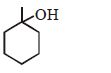
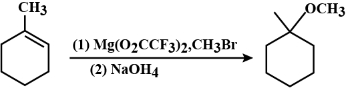
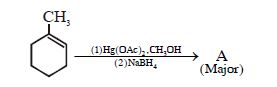
The product $(A)$ of given oxymercuration demercuration is
  • A


  • C

  • D

Answer

Correct option: B.

b
Alkoxymercuration demecuration is a reaction in which as alkene and alcohol reacts to form an alkoxy mercury intermediate in presence of mercuric acetate leagent to yield ether on geather reduction with $NaBH _4$.

Need a full question paper?

Generate a complete, print-ready paper with questions like this in minutes — across 16+ boards, with answer keys.

Start Generating Free

Similar questions

Which one has $s{p^2} - $ hybridisation
$IUPAC$ name of $C{H_2} = CH - CH(C{H_3}C{H_2})\mathop {\mathop {C = }\limits_{|\,\,\,\,\,} }\limits_{Br} C{H_2}$ is …..
The $IUPAC$ name of the compound $CH_2 = CH -CH(CH_3)_2$ is
The spin-only magnetic moment value of an octahedral complex among $CoCl _{3} \cdot 4 NH _{3}$, $NiCl _{2} \cdot 6 H _{2} O$ and $PtCl _{4} \cdot 2 HCl$, which upon reaction with excess of $AgNO _{3}$ gives $2\, moles$ of $AgCl$ is $....\,B.M.$ (Nearest Integer)
The correct statements from following are:

$A$. The strength of anionic ligands can be explained by crystal field theory.

$B$. Valence bond theory does not give a quantitative interpretation of kinetic stability of coordination compounds.

$C$. The hybridization involved in formation of $\left[\mathrm{Ni}(\mathrm{CN})_4\right]^{2-}$ complex is $\mathrm{dsp}^2$.

$D$. The number of possible isomer$(s)$ of cis- $\left[\mathrm{PtCl}_2(\text { en })_2\right]^{2+}$ is one

Choose the correct answer from the options given below:

When an electron revolves in a stationary orbit then
What volume of ammonia is required to react with $250\,mL$ of oxygen by following the reaction at same conditions ............. $\mathrm{mL}$

$4NH_3 + 5O_2 \to 4NO + 6H_2O$

The compound which gives off oxygen on moderate heating is
Which solution has the highest vapour pressure?
The formation of the oxide ion $O^{2-}(g)$ requires first an exothermic and then  an endothermic step as shown below

$O(g) + e^- \to O^-(g);  \Delta H = - 142 \,kJ \,mol^{-1}$

$O^-(g) + e \to O^{2-} (g); \Delta H = 844\, kJ \,mol^{-1}$

This is because