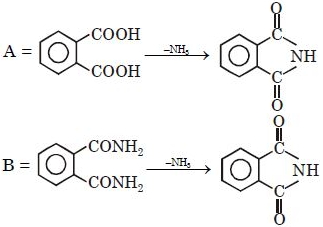
MCQ
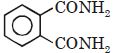
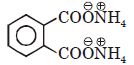
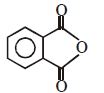
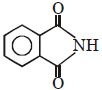
The product $(C)$ will be
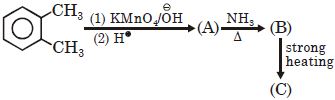
  • A

  • B

  • C


Answer

Correct option: D.

d

Need a full question paper?

Generate a complete, print-ready paper with questions like this in minutes — across 16+ boards, with answer keys.

Start Generating Free

Similar questions

Which of the following alkenes on acid$-$catalysed hydration gives a tertiary alcohol:
If $1$ molal solution of benzoic acid in benzene has a freezing point depression of $2.56\,^oC$.
$(K_f = 5.12\,^oC\,mol^{-1}\, kg)$ and boiling point elevation of $2.53\,^oC$ $(K_b = 2.53\,^oC\,mol^{-1}\,kg)$, then select the correct statement/s :
Statement $I :$ there is dimer formation when undergoing freezing.

Statement $II :$ there is no change when undergoing boiling

Statement $III :$ reverse of $I$ and $II$

Statement $IV :$ dimer formation in freezing and boiling state

Which one of the following compounds is found abundantly in nature
Given below are half cell reactions:

$MnO _{4}^{-}+8 H ^{+}+5 e ^{-} \rightarrow Mn ^{2+}+4 H _{2} O$,

$E^{o} _{ Mn ^{2+} / MnO _{4}^{-}}=-1.510 \,V$

$\frac{1}{2} O _{2}+2 H ^{+}+2 e ^{-} \rightarrow H _{2} O$,

$E _{ O _{2} / H _{2} O }^{o}=+1.223 \,V$

Will the permanganate ion, $MnO _{4}^{-}$liberate $O _{2}$ from water in the presence of an acid ?

On passing one faraday of electricity through the electrolytic cells containing $A{g^ + },\,N{i^{ + 2}}$ and $C{r^{ + 3}}$ions solution, the deposited $Ag\,(At.\,wt. = 108),\,Ni\,(At.\,wt. = 59)$ and $Cr\,(At.\,wt. = 52)$ is

$Ag$ , $Ni$ , $Cr$

If $96500$ coulombs of electricity liberates one gram equivalent of any substance, the time taken for a current of $0.15\, amperes$ to deposite $20\,mg$ of copper from a solution of copper sulphate is (Chemical equivalent of copper = $32$)
Which one of the following paramagnetic in nature?
At equilibrium, the rate of dissolution of a solid solute in a volatile liquid solvent is:
A reaction was found to be second order with respect to the concentration of carbon monoxide. If the concentration of carbon monoxide is doubled, with everything else kept the same, the rate of reaction will
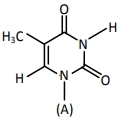
The compound $'A'$ is a complementary base of in $DNA$ stands.