MCQ
The product obtained when acetic acid is treated with phosphorus trichloride is
- A$C{H_3}COOPC{l_3}$
- B$C{H_3}COOCl$
- ✓$C{H_3}COCl$
- D$ClC{H_2}COOH$
Generate a complete, print-ready paper with questions like this in minutes — across 16+ boards, with answer keys.
A current was passed for $10$ hours. $10.8\ g Ag$ was deposited at cathode in $(III)$ electrolytic cell during electrolysis if current efficiency is $50\%.$
If $Z_1,$ $Z_2$ and $Z_3$ be the electrochemical equivalent in the formation of $H_2, Cu$ and $Ag$ respectively, hence $Z_1 : Z_2 : Z_3$ would be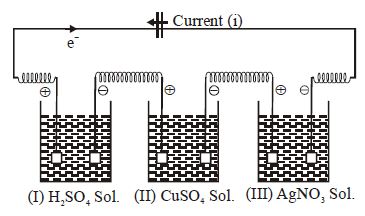
$I-$ acid catalysed hydration
$II-$ $HBO$
$III-$ oxymercuration-demercuration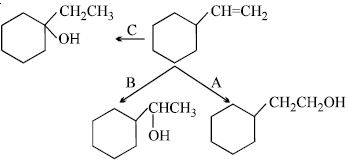
| $M^{x+}\, (aq)\,/M(s)$ |
$A{u^{3 + }}(aq)/$ $Au(s)$ |
$A{g^ + }(aq)/$ $Ag(s)$ |
$F{e^{3 + }}(aq)/$ $F{e^{2 + }}(aq)$ |
$F{e^{2 + }}(aq)/$ $Fe(s)$ |
| $E^o\,M^{x+}$ $\,/M(V)$ | $1.40$ | $0.80$ | $0.77$ | $-0.44$ |
If $E_{Z{n^{2 + }}/Zn}^o = - 0.76\,V,$ which cathode will given a maximum value of $E_{cell}^o$ per electron transferred?
(Image)
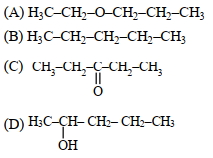
The increasing order of boiling point is :
Choose the correct answer from the options given below :