MCQ
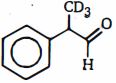
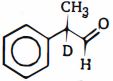
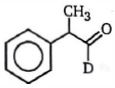
The product of this reaction should be
  • A


  • C

  • D
    All of these

Answer

Correct option: B.

b
$(b)$ Benzylic carbon gets negative charge. $\therefore$ It exchange its $H$ by $D$.

Need a full question paper?

Generate a complete, print-ready paper with questions like this in minutes — across 16+ boards, with answer keys.

Start Generating Free

Similar questions

Newmann projection representation of. . . . ..  Then $X$ and $Y$ are respectively :

$\begin{array}{*{20}{c}} {{H_3}C - C{H_2} - CH - Et} \\ {\,\,\,\,\,\,\,\,\,\,\,\,\,\,\,\,\,\,\,\,\,\,\,\,\,\,\,\,\,\,\,\,\,\,\,|\,\,\,\,\,\,\,\,\,\,\,\,\,\,\,\,\,\,\,} \\ {\,\,\,\,\,\,\,\,\,\,\,\,\,\,\,\,\,\,\,\,\,\,\,\,\,\,\,\,\,\,\,\,\,\,\,\,C{H_3}\,\,\,\,\,\,\,\,\,\,\,\,\,\,\,} \end{array}$ about $C_2-C_3$ is (figure) 

Which will not give purple colour with ninhydrin
There are four complexes of $Ni.$ Select the complex(es) which will be attracted  by magnetic field :

$(I)\, [Ni(CN)_4]^{2-}\,\,\,(II)\, [NiCl_4]^{2-}\,\,\,(III)\,Ni(CO_4)\,\,\,$

$(IV)\, [Ni(H_2O)_6 ]^{2+}$

The indicator used in the titration of sodium carbonate with sulphuric acid is
The standard reduction potentials at $298\,K$ for the following half reactions are given against each

$Z{n^{2 + }}\,(aq)\, + \,2e\, \rightleftharpoons \,Zn\,(s)\,;\, - \,0.762\,V$

$C{r^{3 + }}\,(aq)\, + \,3e\, \rightleftharpoons \,Cr(s)\,;\, - \,0.740\,\,V$

$2{H^ + }\,(aq)\, + \,2e\, \rightleftharpoons \,{H_2}(g)\,;\,\,\,0.00\,\,\,V$

$F{e^{3 + }}\,(aq)\, + \,e\, \rightleftharpoons \,F{e^{2 + }}(aq)\,;\,\,\,0.770\,\,\,V$

Which is the strongest reducing agent ?

Given below are two statements: one is labelled as Assertion $(A)$ and the other is labelled as Reason $(R)$

Assertion $(A)$ : Boron is unable to form $BF _{6}^{3-}$

Reason $(R)$ : Size of $B$ is very small.

In the light of the above statements, choose the correct answer from the options given below.
A $10\,g$ piece of iron $(C = 0.45\, J/g\,^oC)$ at $100\,^oC$ is droped into $25\, g$ of water $(C = 4.2\, J/g\,^oC)$ at $27\,^oC$. Then find temperature of the iron and water system at thermal equilibrium.....$^oC$
Product/s obtained is/are
In aldehydes and ketones, carbon of carbonyl group is
For the given first order reaction $\text { A } \rightarrow \text { B }$ the half life of the reaction is $0.3010\,min$. The ratio of the initial concentration of reactant to the concentration of reactant at time $2.0\,min$ will be equal to $........$ (Nearest integer)