Question
The Product $\sqrt[3]{2}\times\sqrt[4]{2}\times\sqrt[12]{32}$ is equal to:

Answer

  1. $2$
    Solution:
    $\sqrt[3]{2}\times\sqrt[4]{2}\times\sqrt[12]{32}$
    $=\sqrt[3]{2}\times\sqrt[4]{2}\times\sqrt[12]{(2)^5}$
    $=(2)^{\frac{1}{3}}\times(2)^{\frac{1}{4}}\times(2)^{\frac{5}{15}}$
    $=(2)^{\frac{1}{3}+\frac{1}{4}+\frac{5}{12}}$
    $=(2)^{\frac{4+3+5}{12}}$
    $=(2)^{\frac{12}{12}}$
    $=2$

Need a full question paper?

Generate a complete, print-ready paper with questions like this in minutes — across 16+ boards, with answer keys.
Start Generating Free

Similar questions

In the following, write the correct answer.
D is point on the side BC of a $\triangle\text{ABC}$ such that AD bisects Then.
  1. BC = CD
  2. BA > BD
  3. BD > BA
  4. CD > CA
The value of $7^{\frac{1}{2}}.8^{\frac{1}{2}}$ is:
  1. $(28)^\frac{1}{2}$
  2. $(56)^\frac{1}{2}$
  3. $(14)^\frac{1}{2}$
  4. $(42)^\frac{1}{2}$
The graph of y = 5 is a line:
  1. Making an intercept 5 on the x-axis.
  2. Making an intercept 5 on the y-axis.
  3. Parallel to the x-axis at a distance of 5 units from the origin.
  4. Parallel to the y-axis at a distance of 5 units from the origin.
The diagonals AC and BD of a rectangle ABCD intersect each other at P. If $\angle\text{ABD}=50^\circ,$ then $\angle\text{DPC}=$
  1. 70°
  2. 90°
  3. 80°
  4. 100°
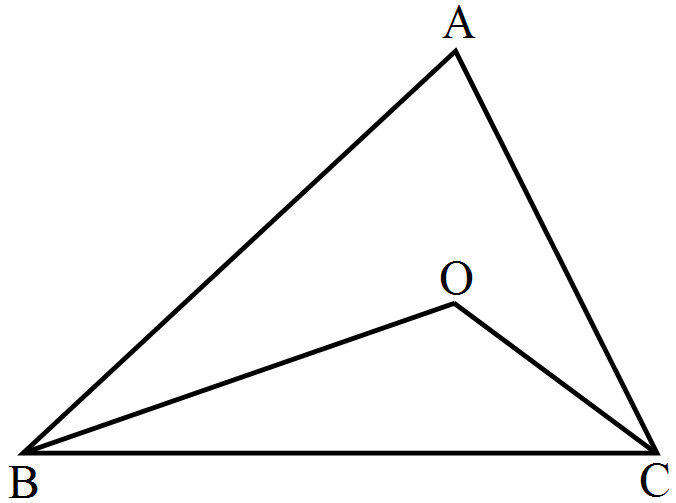
In the given figure, AB > AC. If BO and CO are the bisectors of $\angle\text{B}$ and $\angle\text{C}$respectively, then:
  1. OB < OC
  2. OB = OC
  3. OB > OC
In figure, AB || CD || EF and GH || KL. The measure of $\angle\text{HKL},$ is:
  1. 85°
  2. 135°
  3. 145°
  4. 215°
If $\frac{3^{2\text{x}-8}}{225}=\frac{5^3}{5^{\text{x}}},$ then x =
Two coins are tossed 1000 times and the outcomes are recorded as given below:
Number of heads
2
1
0
Frequency
200
550
250
Now, if two coins are tossed at random, what is the probability of getting at most one head?
  1. $\frac{3}{4}$
  2. $\frac{4}{5}$
  3. $\frac{1}{4}$
  4. $\frac{1}{5}$
$\text{ABCD}$ is a rectangle with $O$ as any point in its interior. If $\text{ar}(\triangle\text{AOD})=3\text{cm}^2$ and $\text{ar}(\triangle\text{ABOC})=6\text{ cm}^2,$ then area of rectangle $\text{ABCD}$ is: