MCQ
The quadratic equation $2 x^2-\sqrt{5} x+1=0$ has
  • A
    two distinct real roots
  • B
    two equal real roots
  • no real roots
  • D
    more than 2 real roots

Answer

Correct option: C.
no real roots

Need a full question paper?

Generate a complete, print-ready paper with questions like this in minutes — across 16+ boards, with answer keys.
Start Generating Free

Similar questions

Aarushi sold $100$ lottery tickets in which $5$ tickets carry prizes. If Priya purchased a ticket, what is the probability of Priya winning a prize?
If the sum of the roots of the equation $x^2-(k+6) x+2(2 k-1)=0$ is equal to half of their product, then $k =$
The common difference of the A.P. $\frac{1}{3}, \frac{1-3 b}{3}, \frac{1-6 b}{3}, \cdots$ is
If the point $C(k, 4)$ divides the join of the points $A(2, 6)$ and $B(5, 1)$ in the ratio $2 : 3$ then the value of $k$ is :
Directions : In the following questions, a statement of assertion $(A)$ is followed by a statement of reason $(R).$ Mark the correct choice as :
Assertion : In a right $\triangle\text{ABC}$, right angled at $B,$ if $ \tan\text{A}=1$, then $ 2\sin\text{A}$. $ \cos\text{A}=1$
Reason : $ \text{cosec}\text { A}$ is the abbreviation used for cosecant of angle $A$.
the lengths of the diagonals of a rhombus are $24\ cm$ and $10\ cm$. The length of each side of the rhombus is :
If the system of equations is inconsistent, then $k = 3x + y = 1(2k - 1)x + (k - 1)y = 2k + 13x + y = 12k - 1x + k - 1 = 2k + 1.$
Mark the correct alternative in the following : If the sum of $P$ terms of an $A.P$. is $q$ and the sum of $q$ terms is $p,$ then the sum of $p + q$ terms will be :
If the zeroes of a quadratic polynomial $ax^2+ bx + c$, $\text{C}\neq{0}$ are equal, then :
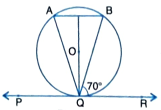
In Fig. if $P Q R$ is the tangent to a circle at $Q$ whose centre is $O, A B$ is a chord parallel to $P R$ and $\angle B Q R=70^{\circ}$, then $\angle A Q B$ is equal to
Image