MCQ
The quantities $A$ and $B$ are related by the relation, $m = A/B$, where $m$ is the linear density and $A$ is the force. The dimensions of $B$ are of
  • A
    Pressure
  • B
    Work
  • Latent heat
  • D
    None of the above

Answer

Correct option: C.
Latent heat
c
(c) $m$ = linear density = mass per unit length = $\left[ {\frac{M}{L}} \right]$

$A= force =$ $[ML{T^{ - 2}}]\;$  [B]=$\frac{{[A]}}{{[m]}} = \frac{{[ML{T^{ - 2}}]}}{{[M{L^{ - 1}}]}}$$ = [{L^2}{T^{ - 2}}]$

This is same dimension as that of latent heat.

Need a full question paper?

Generate a complete, print-ready paper with questions like this in minutes — across 16+ boards, with answer keys.
Start Generating Free

Similar questions

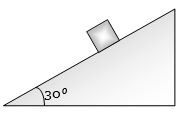
The time taken by a block of wood (initially at rest) to slide down a smooth inclined plane $9.8\, m$ long (angle of inclination is ${30^o}$) is.........$sec$
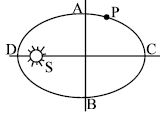
Figure shows the orbit of a planet $P$ round the sun $S.$ $AB$ and $CD$ are the minor and major axes of the ellipse.

If $U$ is the potential energy and $K$ kinetic energy then $|U| > |K|$ at
A player throws a ball that reaches to the another player in $4\,s$. If the height of each player is $1.5\,m$, the maximum height attained by the ball from the ground level is  .......... $m$
A ball will a speed of $9\, m / s$ collides with another identical ball at rest. After the collision, the direction of each ball makes an angle of $30^{\circ}$ with the original direction. The ratio of velocities of the balls after collision is $x : y$ where $x$ is........
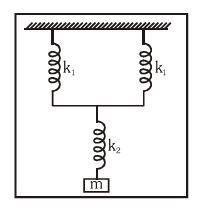
The total spring constant of the system as shown in the figure will be
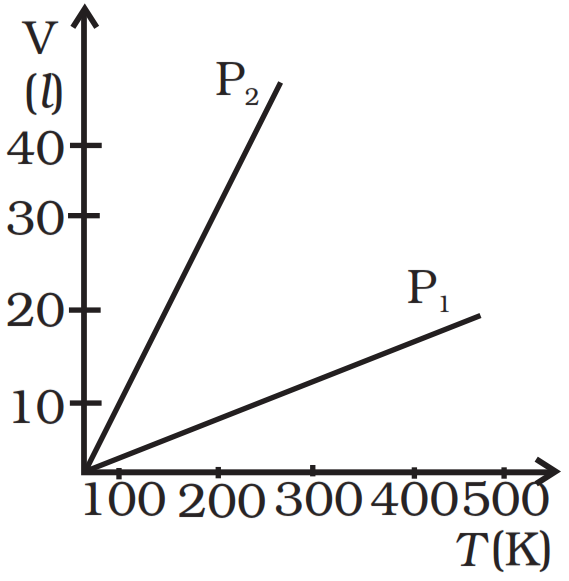
Volume versus temperature graphs for a given mass of an ideal gas are shown in figure. At two different values of constant pressure. What can be inferred about relation between P1 and P2?

  1. P1 > P2
  2. P1 = P2
  3. P< P2
  4. Data is insufficient.
Two projectiles of same mass and with same velocity are thrown at an angle $60^o$ and $30^o$ with the horizontal, then which quantity will remain same
A particle starts moving rectilinearly at time $t = 0$ such that its velocity $'v'$ changes with time $'t'$ according to the equation $v = t^2 - t$ where $t$ is in seconds and $v$ is in $m/s.$ The time interval for which the particle retards is
In a p-n junction:
  1. New holes and conduction electrons are produced continuously throughout the material.
  2. New holes and conduction electrons are produced continuously throughout the material except in the depletion region.
  3. Holes and conduction electrons recombine continuously throughout the material.
  4. Holes and conduction electrons recombine continuously throughout the material except in the depletion region.
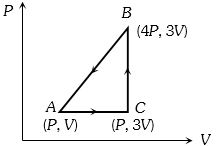
A sample of ideal monoatomic gas is taken round the cycle $ABCA$ as shown in the figure. The work done during the cycle is