MCQ
The quantity of radiation emitted by a surface per second depends upon :
  • A
    only surface area
  • B
    only the nature of surface
  • C
    temperature difference of surface and environment
  • all of the above

Answer

Correct option: D.
all of the above
D

Need a full question paper?

Generate a complete, print-ready paper with questions like this in minutes — across 16+ boards, with answer keys.
Start Generating Free

Similar questions

If $V$ is the gravitational potential due to sphere of uniform density on it's surface, then it's value at the center of sphere will be:-
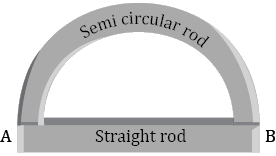
Two rods (one semi-circular and other straight) of same material and of same cross-sectional area are joined as shown in the figure. The points $A$ and $B$ are maintained at different temperature. The ratio of the heat transferred through a cross-section of a semi-circular rod to the heat transferred through a cross section of the straight rod in a given time is
Match Column $- I$ and Column $- II$ and choose the correct match from the given choices.
Column $- I$ Column $- II$
$(A)$ Root mean square speed of gas molecules $(P)$ $\frac{1}{3} \mathrm{n} m \bar{v}^{2}$
$(B)$ Pressure exerted by ideal gas $(Q)$ $\sqrt{\frac{3 \mathrm{RT}}{\mathrm{M}}}$
$(C)$ Average kinetic energy of a molecule $(R)$ $\frac{5}{2} \mathrm{RT}$
$(D)$ Total internal energy  of $1$ mole of a diatomic gas $(S)$ $\frac{3}{2} \mathrm{k}_{\mathrm{B}} \mathrm{T}$
It takes one minute for a passenger standing on an escalator to reach the top. If the escalator does not move it takes him $3$ minute to walk up . ....... $\sec$ long will it take for the passenger to arrive at the top if he walks up the moving escalator ?
A sphere of mass $m,$ moving with a speed $v,$ strikes a wall elastically at an angle of incidence $I$. If the speed of the sphere before and after collision is the same and the angle of incidence and velocity normally towards the wall the angle of rebound is equal to the angle of incidence and velocity normally towards the wall is taken as negative then, the change in the momentum parallel to wall is:
In a simple pendulum experiment for determination of acceleration due to gravity $(g)$, time taken for $20$ oscillations is measured by using a watch of $1\, second$ least count. The mean value of time taken comes out to be $30\,s$. The length of pendulum is measured by using a meter scale of least count $1\, mm$ and the value obtained is $55.0\, cm$. The percentage error in the determination of $g$ is close to  ........... $\%$
A disc of radius $R$ and mass $M$ is rolling horizontally without slipping with speed $v$. It then moves up an inclined smooth surface as shown in figure. The maximum height that the disc can go up the incline is:
A spherical bubble inside water has radius $R$. Take the pressure inside the bubble and the water pressure to be $p_0$. The bubble now gets compressed radially in an adiabatic manner so that its radius becomes $(R-a)$. For $a \ll R$ the magnitude of the work done in the process is given by $\left(4 \pi p_0 R a^2\right) X$, where $X$ is a constant and $\gamma=C_p / C_V=41 / 30$. The value of $X$ is. . . . . .
The radii of two planets are respectively $R_1$ and $R_2$ and their densities are respectively $P_1$ and $P_2$. The ratio of the accelerations due to gravity at their surfaces:
A force of $5 \,N$ acts on a body of weight $9.8 \,N$. What is the acceleration produced in $m/{\sec ^2}$