Question
The radioactive isotope D decays according to the sequence $\text{D}\xrightarrow{\beta}^{- }$ $\text{D}_{1}\xrightarrow{\alpha - particle}$ $\text{D}_{2}$If the mass number and atomic number of $\text{D}_{1}$ are 176 and 71 respectively, what is (i) the mass number (ii) atomic number of D?
Answer

  1. Mass number 180
  2. Atomic number 72
Alternate Answer
$\text{D}^{180}_{72}$

Need a full question paper?

Generate a complete, print-ready paper with questions like this in minutes — across 16+ boards, with answer keys.

Start Generating Free

Similar questions

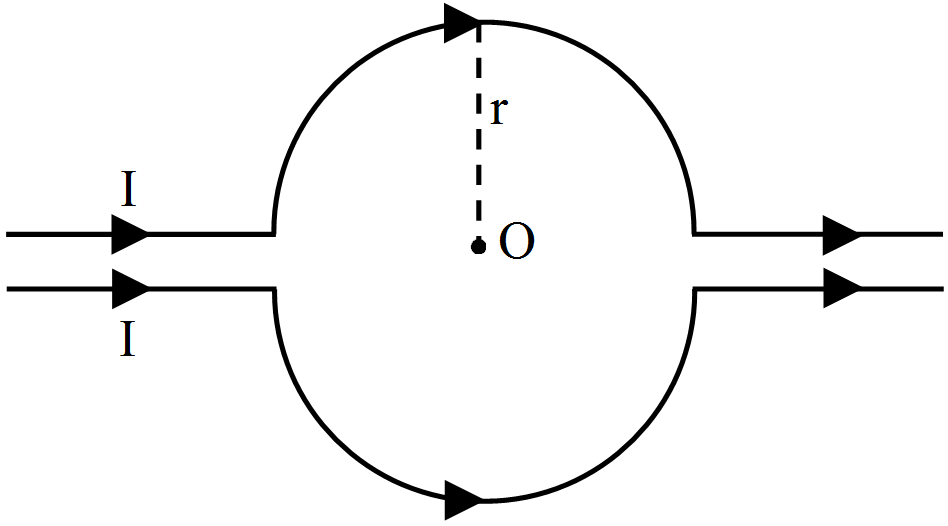
What is the value of magnetic field at point O due to current flowing in the wires?
Answer the following questions:
Magnetic field lines are always nearly normal to the surface of a ferromagnet at every point. (This fact is analogous to the static electric field lines being normal to the surface of a conductor at every point.) Why?
Identify the type of waves which are produced by the following way and write one application for each:
  1. Radioactive decay of the nucleus.
  2. Rapid acceleration and decelerations of electrons in aerials.
  3. Bombarding a metal target by high energy electrons.
The sun is less bright at morning and evening as compared to at noon although its distance from the observer is almost the same. Why?
Name charge carriers in p-type semiconductor.
What is the shape of equipotential surfaces due to the following? (a) Due to point charge (b) Due to uniform electric field.
A diverging lens of focal length 20cm and a converging mirror of focal length 10cm are placed coaxially at a separation of 5cm. Where should an object be placed so that a real image is formed at the object itself?
Can mirrors give rise to chromatic aberration?
Two coils one of larger radius $R$ and other of smaller radius $r$ are kept near. If mutual induction coefficient for this pair is $1 mH$ what is the magnetic flux associated with the larger coil when a current of $0.5 A$ is flowing in the smaller coil? When current in smaller coil is zero then what is its effect on larger coil?
What is the nature of magnetic field in a moving coil galvanometer?