Question
The radius of a sphere shrinks from 10 to 9.8cm. Find approximately the decrease in its volume.
Answer

Let $\text{x}=10,\\\text{x}+\triangle\text{x}=9.8$
$\triangle\text{x}=9.8-\text{x}$
$=9.8-10$
$\triangle\text{x}=-0.2$
$\text{y}=\frac{4}{3}\pi\text{x}^3$
$\frac{\text{dy}}{\text{dx}}=4\pi\text{r}^2$
$\Big(\frac{\text{dy}}{\text{dx}}\Big)_{\text{x}\Rightarrow10}=4\pi(10)^2$
$\Big(\frac{\text{dy}}{\text{dx}}\Big)_{\text{x}\Rightarrow10}=400\pi\ \text{cm}^2$
$=400\pi\times(-0.2)$
$\triangle\text{y}=-80\pi\ \text{cm}^3$
so, approximate decrease in volume is $80\pi\ \text{cm}^3$

Need a full question paper?

Generate a complete, print-ready paper with questions like this in minutes — across 16+ boards, with answer keys.

Start Generating Free

Similar questions

Solve the following system of equations by matrix method:
$6x - 12y + 25z = 4$
$4x + 15y - 20z = 3$
$2x + 18y + 15z = 10$
In each of the show that the given differential equation is homogeneous and solve each of them. $\Bigg\{\text{x}\cos\bigg(\frac{\text{y}}{\text{x}}\bigg)+\text{y sin}\bigg(\frac{\text{y}}{\text{x}}\bigg)\Bigg\}\text{y dx}$ $=\Bigg\{\text{y}\sin\bigg(\frac{\text{y}}{\text{x}}\bigg)-\text{x cos}\bigg(\frac{\text{y}}{\text{x}}\bigg)\Bigg\}\text{x dy}$ 
Find the value of a and b so that the function f(x) defind by $\text{f(x)}=\begin{cases}\text{x}+\text{a}\sqrt{2}\sin\text{x},&\text{if }0\leq\text{x}<\frac{\pi}{4}\\2\text{x}\cot\text{ x}+\text{b},&\text{if }\frac{\pi}{4}\leq\text{x}<\frac{\pi}{2}\\\text{a}\cos2\text{x}-\text{b}\sin\text{x},&\text{if }\frac{\pi}{2}\leq\text{x}\leq\pi\end{cases}$ becomes continuous on $[0,\pi]$
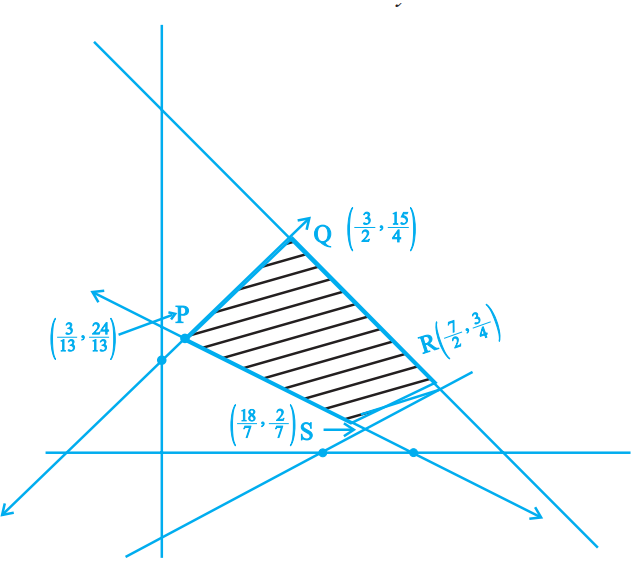
In the feasible region (shaded) for a LPP is shown. Determine the maximum and minimum value of Z = x + 2y.
Evaluate the following integrals as limit of sum:
$\int\limits^3_1(3\text{x}-2)\text{dx}$
Find $A$ and $B$ so that $\text{y}=\text{A}\sin3\text{x}+\text{B}\cos3\text{x}$ satisfy the equation $\frac{\text{d}^2\text{y}}{\text{dx}^2}+4\frac{\text{dy}}{\text{dx}}+3\text{y}=10\cos3\text{x}.$
If $\text{x}=\text{a}(\theta+\sin\theta),\text{y}=\text{a}(1+\cos\theta),$ find $\frac{\text{dy}}{\text{dx}}.$
Evaluate the following integrals:
$\int\limits^{2\pi}_0\frac{\text{e}^{\sin\text{x}}}{\text{e}^{\sin\text{x}}+\text{e}^{-\sin\text{x}}}\text{ dx}$
If $\text{x}=\text{a}(\theta+\sin\theta),\text{y}=\text{a}(1+\cos\theta),$ find $\frac{\text{dy}}{\text{dx}}.$
Find a unit vector perpendicular to the plane A B C, where the coordinates of A, B and C are A (3, -1, 2), B (1, -1, -3) and C (4, -3, 1).