MCQ
The range of a projectile when launched at angle $\theta$ is same as when launched at angle $2 \theta$. What is the value of $\theta$ ?
  • A
    $15$
  • $30$
  • C
    $45$
  • D
    $60$

Answer

Correct option: B.
$30$
b
(b)

$2 \theta=90^{\circ}-\theta$

or $3 \theta=90^{\circ} \text { or } \theta=30^{\circ}$

Need a full question paper?

Generate a complete, print-ready paper with questions like this in minutes — across 16+ boards, with answer keys.
Start Generating Free

Similar questions

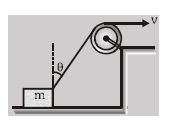
A block is dragged on a smooth plane with the help of a rope which moves with a velocity $v$ as shown in figure. The horizontal velocity of the block is
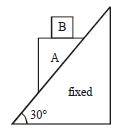
In the given figure acceleration of wedge $'A'$ is $10\ m/s^2$ along the inclined plane. (There is no friction between $A$ $\&$ $B$ and $A$ $\&$ fixed inclined plane.) Then acceleration of block $'B'$ will ............ $m/s^2$
The unit of permittivity of free space is
Shearing stress causes change in
Distribution of energy in the spectrum of a black body can be correctly represented by
If work done in increasing the size of a soap film from $10\;cm \times 6\;cm$ to $10\;cm \times 11\;cm$ is $2 \times {10^{ - 4}}\,J,$ then the surface tension is
The resultant amplitude of amplitude $a_1$ and $a_2$ with same frequency while phase difference $\frac{\pi}{2}$.
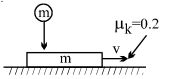
$A$ ball of mass $m$ falls vertically from a height $h$ and collides with $a$ block of equal mass $m$ moving horizontally with $a$ velocity $v$ on $a$ surface. The coefficient of kinetic friction between the block and the surface is $0.2$, while the coefficient of restitution $e$ between the ball and the block is $0.5.$ There is no friction acting between the ball and the block. The velocity of the block decreases by
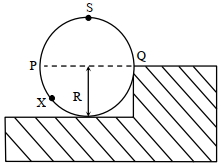
A wheel of radius $R$ and mass $M$ is placed at the bottom of a fixed step of height $R$ as shown in the figure. A constant force is continuously applied on the surface of the wheel so that it just climbs the step without slipping. Consider the torque $\tau$ about an axis normal to the plane of the paper passing through the point $Q$. Which of the following options is/are correct?

(image)

A boy on a cycle pedals around a circle of $20\, metres$ radius at a speed of $20\,metres/\sec .$ The combined mass of the boy and the cycle is $90\, kg$. The angle that the cycle makes with the vertical so that it may not fall is ......... $^o$ $(g = 9.8\,m/{\sec ^2})$