MCQ
The range of $f(x) = \cos x - \sin x$ is
  • A
    $( - 1,\;1)$
  • B
    $[ - 1,\,\;1)$
  • C
    $\left[ { - \frac{\pi }{2},\;\frac{\pi }{2}} \right]$
  • $[ - \sqrt 2 ,\;\sqrt 2 ]$

Answer

Correct option: D.
$[ - \sqrt 2 ,\;\sqrt 2 ]$
d
(d) Since maximum and minimum values of $\cos x - \sin x$ are $\sqrt 2 $ and $ - \sqrt 2 $ respectively,

therefore range of $f(x)$ is $[ - \sqrt 2 ,\,\,\sqrt 2 ].$

Need a full question paper?

Generate a complete, print-ready paper with questions like this in minutes — across 16+ boards, with answer keys.
Start Generating Free

Similar questions

The equation of circle described on the chord $3x + y+ 5\, = 0$ of the circle $x^2 + y^2\, = 16$ as diameter is
Suppose that the sides $a,b, c$ of a triangle $A B C$ satisfy $b^2=a c$. Then the set of all possible values of $\frac{\sin A \cot C+\cos A}{\sin B \cot C+\cos B}$ is
The value of a such that $x^2-11 x+a=0$ and $x^2-14 x+2 a=0$ may have a common root is:
Let $n$ be a positive integer. Let  $A =\sum_{ k =0}^{ n }(-1)^{ k } n _{ C _{ k }}\left[\left(\frac{1}{2}\right)^{ k }+\left(\frac{3}{4}\right)^{ k }+\left(\frac{7}{8}\right)^{ k }+\left(\frac{15}{16}\right)^{ k }+\left(\frac{31}{32}\right)^{ k }\right]$ . If $63 A =1-\frac{1}{2^{30}},$ then $n$ is equal to ...... .
If $m$ and $n$ respectively are the numbers of positive and negative value of $\theta$ in the interval $[-\pi, \pi]$ that satisfy the equation $\cos 2 \theta \cos \frac{\theta}{2}=\cos 3 \theta \cos \frac{9 \theta}{2}$, then $mn$ is equal to $.............$.
The equation $\frac{(2 \text{x})}{2} - \frac{(\text{y}{ 2})}{2} = -3,$ if x = -2, then y is equal to:
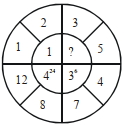
The missing value in the following figure is
If one of the diameters of the circle $x^2+y^2-10 x+$ $4 y+13=0$ is a chord of another circle $C,$ whose center is the point of intersection of the lines $2 x+$ $3 y=12$ and $3 x-2 y=5$, then the radius of the circle $\mathrm{C}$ is
If $\sin \theta  = \frac{1}{2}\left( {\sqrt {\frac{x}{y}\,}  + \,\sqrt {\frac{y}{x}} } \right)\,,\,\left( {x,y \in R\, - \{ 0\} } \right)$. Then
The number of integral terms in the expansion of ${({5^{1/2}} + {7^{1/6}})^{642}}$ is