MCQ
The range of $f(x)=4 \sin ^{-1}\left(\frac{x^2}{x^2+1}\right)$ is
  • A
    $[0, \pi]$
  • $[0,2 \pi)$
  • C
    $[0, \pi)$
  • D
    $[0,2 \pi]$

Answer

Correct option: B.
$[0,2 \pi)$
b
$f(x)=4 \sin ^{-1}\left(\frac{x^2}{x^2+1}\right)$

$\frac{x^2+1-1}{x^2+1}=1-\frac{1}{x^2+1} \Rightarrow[0,1)$

Range of $f(x)=[0,2 \pi)$

Need a full question paper?

Generate a complete, print-ready paper with questions like this in minutes — across 16+ boards, with answer keys.
Start Generating Free

Similar questions

If the binary operation $\odot$ is defined on the set Q+ of all positive rational numbers by $\text{a}\odot\text{b}=\frac{\text{ab}}4$. Then, $3\odot\Big(\frac{1}5\odot\frac{1}2\Big)$ is equal to:
  1. $\frac{3}{160}$
  2. $\frac{5}{160}$
  3. $\frac{3}{10}$
  4. $\frac{3}{40}$
The maximum value of $e^{(2 + \sqrt 3 \cos x + \sin x)}$ is
The domain of ${\sin ^{ - 1}}({\log _3}x)$ is
Which of the following function $(s)$ is/are Transcidental?
Choose the correct answer in Exercise:
$\int\frac{\text{dx}}{\sqrt{9\text{x}-4\text{x}^2}}\text{equals}$
  1. $\frac{1}{9}\sin^{-1}\bigg(\frac{9\text{x}-8}{8}\bigg)+\text{C}$
  2. $\frac{1}{2}\sin^{-1}\bigg(\frac{8\text{x}-9}{9}\bigg)+\text{C}$
  3. $\frac{1}{3}\sin^{-1}\bigg(\frac{9\text{x}-8}{8}\bigg)+\text{C}$
  4. $\frac{1}{2}\sin^{-1}\bigg(\frac{9\text{x}-8}{9}\bigg)+\text{C}$
The relation R = {(1, 1), (2, 2), (3, 3)} on the set {1, 2, 3} is:
  1. Symmetric only.
  2. Reflexive only.
  3. An equivalence relation.
  4. Transitive only.
The roots of the equation $\left| {\,\begin{array}{*{20}{c}}x&0&8\\4&1&3\\2&0&x\end{array}\,} \right| = 0$ are equal to
Choose the correct answer from the given four option.
The differential equation for $\text{y}=\text{A}\cos\alpha\text{x}+\text{B}\sin\alpha\text{x},$ where A and B are arbitrary constants is:
  1. $\frac{\text{d}^2\text{y}}{\text{d}\text{x}^2}-\alpha^2\text{y}=0$
  2. $\frac{\text{d}^2\text{y}}{\text{d}\text{x}^2}+\alpha^2\text{y}=0$
  3. $\frac{\text{d}^2\text{y}}{\text{d}\text{x}^2}+\alpha\text{y}=0$
  4. $\frac{\text{d}^2\text{y}}{\text{d}\text{x}^2}-\alpha\text{y}=0$
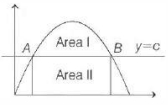
The figure shows a portion of the graph $y=2 x-4 x^3$.The line $y=c$ is such that the areas of the regions marked $I$ and $II$ are equal. If $a, b$ are the $x$-coordinates of $A, B$ respectively, then $a+b$ equals
If matrix $A = \left[ {\begin{array}{*{20}{c}}
{\sin \theta }&{\cos ec\theta }&1\\
{\cos ec\theta }&1&{\sin \theta }\\
1&{\sin \theta }&{\cos ec\theta }
\end{array}} \right]$ is a non invertible matrix, then possible value of $'\theta'$ is 

$($ where $n \in I)$