MCQ
The range of the function $f(x) = \frac{x}{{1 + \left| x \right|}},\,x \in R,$ is
  • A
    $R$
  • $(-1,1)$
  • C
    $R-\{0\}$
  • D
    $[-1,1]$

Answer

Correct option: B.
$(-1,1)$
b
$f\left( x \right) = \frac{x}{{1 + \left| x \right|}},x \in R$

If $x > 0,\left| x \right| = x \Rightarrow f\left( x \right) = \frac{x}{{1 + x}}$

which is not defined for $x=-1$

If $x < 0,\left| x \right| =  - x \Rightarrow f\left( x \right) = \frac{x}{{1 - x}}$

which is not defined for $x=1$

Thus $f\left( x \right)$ defined for all value of $R$ except $1$ and $-1$ 

Hence, range $=(-1,1)$.

Need a full question paper?

Generate a complete, print-ready paper with questions like this in minutes — across 16+ boards, with answer keys.

Start Generating Free

Similar questions

If the system of equations $2 \mathrm{x}-\mathrm{y}+\mathrm{z}=4$ $5 x+\lambda y+3 z=12$ $100 \mathrm{x}-47 \mathrm{y}+\mu \mathrm{z}=212$, has infinitely many solutions, then $\mu-2 \lambda$ is equal to
Let $A = \left( {\begin{array}{*{20}{c}}
{\cos \,\alpha }&{ - \sin \,\alpha }\\
{\sin \,\alpha }&{\cos \,\alpha }
\end{array}} \right)$, $\left( {\alpha  \in R} \right)$ such that ${A^{32}} = \left( {\begin{array}{*{20}{c}}
0&{ - 1}\\
1&0
\end{array}} \right)$. Then a value of $\alpha $ is
There are three kinds of liquids $X, Y, Z$. Three jars $J_1, J_2, J_3$ contains $100 ml$ of liquids $X, Y, Z$ respectively. By an operation we mean three steps in the following order

- stir the liquid in $J_1$ and transfer $10\,ml$ from $J_1$ into $J_2$

- stir the liquid in $J_2$ and transfer $10\, ml$ from $J_2$ into $J_3$

- stir the liquid in $J_3$ and transfer $10 \,ml$ from $J_3$ into $J_1$.

After performing the operation four times, let $x, y, z$ be the amounts of $X, Y, Z$ respectively, in $J_1$. Then,

If $\alpha $ is a root of $25{\cos ^2}\theta + 5\cos \theta - 12 = 0$, $\pi /2 < \alpha < \pi $, then $\sin 2\alpha $ is equal to
Let $a, b, c, d$ be in arithmetic progression with common difference $\lambda$. If

$\left|\begin{array}{lll} x+a-c & x+b & x+a \\ x-1 & x+c & x+b \\ x-b+d & x+d & x+c \end{array}\right|=2$

then value of $\lambda^{2}$ is equal to $.....$
One maximum point of ${\sin ^p}x{\cos ^q}x$ is
Let $P(x)=1+x+x^2+x^3+x^4+x^5$. What is the remainder when $P\left(x^{12}\right)$ is divided by $P(x)$ ?
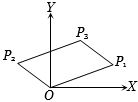
If the points ${P_1}$and ${P_2}$ represent two complex numbers ${z_1}$ and ${z_2}$, then the point ${P_3}$ represents the number
The system of equations  $-k x+3 y-14 z=25$  $-15 x+4 y-k z=3$  $-4 x+y+3 z=4$  is consistent for all $k$ in the set
 The integral $\int_0^{\frac{\pi}{4}} \frac{136 \sin x}{3 \sin x+5 \cos x} d x$ is equal to :