MCQ
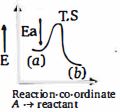
The rate constant for a reaction can be increased by $\underline{a}$ the stability of the reactant or by $\underline{b}$ the stability of the transition state. Select the correct choice for $a$ and $b$
  • A
    decreasing, decreasing
  • B
    increasing, decreasing
  • decreasing, increasing
  • D
    increasing, increasing

Answer

Correct option: C.
decreasing, increasing
c
more the stable reactant and more will activation energy less will be rate constant  more the stable transition stable less will activation energy more is rate of  reaction.

Need a full question paper?

Generate a complete, print-ready paper with questions like this in minutes — across 16+ boards, with answer keys.

Start Generating Free

Similar questions

What weight of $S{O_2}$ can be made by burning sulphur in $5.0$ moles of oxygen .......... $\mathrm{gm}$
The correct order of bound orders of $C _{2}^{2-}, N _{2}^{2-}$ and $O _{2}^{2-}$ is, respectively.
$C{{H}_{3}}-C\equiv C-C{{H}_{3}}\xrightarrow{Cold\,\,KMn{{O}_{4}}}(A)$

Product $(A)$ is

Number of compounds from the following with zero dipole moment is . . . . . .

$\mathrm{HF}, \mathrm{H}_2, \mathrm{H}_2 \mathrm{~S}, \mathrm{CO}_2, \mathrm{NH}_3, \mathrm{BF}_3, \mathrm{CH}_4, \mathrm{CHCl}_3, \mathrm{SiF}_4$, $\mathrm{H}_2 \mathrm{O}, \mathrm{BeF}_2$

A $0.004\, M$ solution of $N{a_2}S{O_4}$ is isotonic with a $0.010 \,M$ solution of glucose at same temperature. The apparent degree of disociation of $N{a_2}S{O_4}$ is.....$\%$
Which of the following does not reduce Benedict's solution
Which of the following is most electronegative
Based on $VSEPR$ model, match the xenon compounds given in $List-I$ with the corresponding. geometries and the number of lone pairs on xenon given in $List-II$ and choose the correct option.
$List-I$ $List-II$
($P$) $XeF _2$ ($1$) Trigonal bipyramidal and two lone pair of electrons
($Q$) $XeF _4$ ($2$) Tetrahedral and one lone pair of electrons
($R$) $XeO _3$ ($3$) Octahedral and two lone pair of electrons
($S$) $XeO _3 F _2$ ($4$) Trigonal bipyramidal and no lone pair of electrons
  ($5$) Trigonal bipyramidal and three lone pair of electrons
If we consider that $1/6$, in place of $1/12$, mass of carbon atom is taken to be the relative atomic mass unit, the mass of one mole of a substance will
The rate constant for the reaction, $2{N_2}{O_5} \to 4N{O_2}$ $ + {O_2}$ is $3 \times {10^{ - 5}}{\sec ^{ - 1}}$. If the rate is $2.40 \times {10^{ - 5}}\,mol\,\,litr{e^{{\rm{ - 1}}}}{\sec ^{ - 1}}$. Then the concentration of ${N_2}{O_5}$ (in mol litre $^{-1}$) is