MCQ
The rate law for reaction $A + 2B = C + 2D$ will be
  • A
    Rate $ = K[A]\,[B]$
  • B
    Rate $ = K[A]\,[2B]$
  • Rate $ = K[A]\,{[B]^2}$
  • D
    Rate $ = K\frac{{[C]{{[D]}^2}}}{{[A]{{[B]}^2}}}$

Answer

Correct option: C.
Rate $ = K[A]\,{[B]^2}$
c
(c) The rate law for an reaction can be given by; rate =$K(A){(B)^2}$, i.e. the powers are raised which are given as coefficient of reactant.

Need a full question paper?

Generate a complete, print-ready paper with questions like this in minutes — across 16+ boards, with answer keys.
Start Generating Free

Similar questions

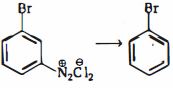
For the transformation the reagent used is
Peptides are
$\begin{array}{*{20}{c}}
  {O\,\,\,\,\,\,\,\,\,\,\,\,\,\,\,\,\,\,\,\,\,\,\,\,\,\,\,\,\,\,\,\,\,\,\,\,\,\,\,\,\,\,\,\,\,\,\,\,\,\,\,\,} \\ 
  {||\,\,\,\,\,\,\,\,\,\,\,\,\,\,\,\,\,\,\,\,\,\,\,\,\,\,\,\,\,\,\,\,\,\,\,\,\,\,\,\,\,\,\,\,\,\,\,\,\,\,\,\,} \\ 
  {Ph - C - OH\xrightarrow[\Delta ]{{N{H_3}}}(A){\mkern 1mu} \xrightarrow[{KOH}]{{B{r_2}}}(B),{\mkern 1mu} } 
\end{array}{\mkern 1mu} {\mkern 1mu}$  product $B$  is
The electrode potentials for

$Cu^{2+}_{(aq)} + e^- \rightarrow Cu^+_{(aq)}$ and $Cu^+_{(aq)} + e^- \rightarrow Cu_{(s)}$ are $+ 0.15\, V$ and $+ 0.50\, V$ respectively. The value of $E^o_{Cu^{2+}/Cu}$ will be ........ $V$

The $EMF$ of the cell $M |M^{n+} (0.02 \,M) || H^+ (1M)| H_2 (g) (1\  atm) $, $Pt$  at   $25\,^oC$ is  $0.81\,V$. Calculate the valency of the metal if the standard oxidation potential of the metal is $0.76V$. (Use $\frac{2.303\,RT}{F} = 0.06 ,\,log\  2 = 0.3$)
The $\pi $ acid ligand which uses its $‘d’$ orbital during synergic bonding in its complex compound is
Ferrous sulphate on heating gives
At room temperature, a dilute solution of urea is prepared by dissolving $0.60\, g$ of urea in $360\, g$ of water. If the vapour pressure of pure water at this temperature is $35\, mm\, Hg$, lowering of vapour pressure will be: .............. $\mathrm{mm\,Hg}$  (molar mass of urea $= 60\, g\, mol^{-1}$)
Which $d-$ orbital of metal in $[Fe(CO)_5]$ is involved in hybridisation
A disaccharide which gives only glucose on hydrolysis is: