MCQ
The ratio between Bohr radii is:
  • A
    $1 : 2 : 3$
  • B
    $2 : 4 : 6$
  • $1 : 4 : 9$
  • D
    $1 : 3 : 5$

Answer

Correct option: C.
$1 : 4 : 9$

$1 : 4 : 9$, In Bohr’s atomic model, $r_n n^2$

Need a full question paper?

Generate a complete, print-ready paper with questions like this in minutes — across 16+ boards, with answer keys.

Start Generating Free

Similar questions

A magnetic field cannot exert any force on a:
The capacitance of the capacitor is inversely proportional to:
In the disintegration series

$_{92}^{238}U\xrightarrow{\alpha }x\xrightarrow{\beta }_Z^AY$

The value of $Z$ and $A$ respectively will be
The amplification factor of a triode is $18$ and its plate resistance is $8 ×10^{3}$. A load resistance of $10^{4} \Omega$ is connected in the plate circuit. The voltage gain will be
Two point charges $ + 3\,\mu C$ and $ + 8\,\mu C$ repel each other with a force of $40\,N$. If a charge of $ - 5\,\mu C$ is added to each of them, then the force between them will become....$N$
Conside ranequi- convex lens of glass $\left( {\mu  = \frac{3}{2}} \right)$ If temperature of lens is increased by $40\, ^oC$ then its focal length remains same. The coefficient of linear expansion of glass is $2.5 \times 1 0^{-4} / \,^oC$ . Calculate change in refractive index of glass on increasing temperature by $40\,^o C$.
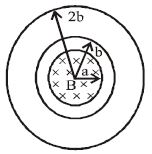
A uniform magnetic field $B$ that is perpendicular to the plane of the page now passes through the loops, as shown. The field is confined to a region of radius $a$, where $a < b$, and is changing at a constant rate. The induced $emf$ in the wire loop of radius $b$ is $\varepsilon $. What is the induced $emf$ in the wire loop of radius $2b$ :-
In a plano-convex lens the radius of curvature of the convex lens is 10 cm. If the plane side is polished, then the focal length will be (Refractive index = 1.5)
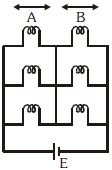
Six similar bulbs are connected as shown in the figure with a $DC$ source of $emf\; E$, and zero internal resistance. The ratio of power consumption by the bulbs when $(i)$ all are glowing and $(ii)$ in the situation when two from section $A$ and one from section $B$ are glowing, will be
Speed of an electron in Bohr's $7^{\text {th }}$ orbit for Hydrogen atom is $3.6 \times 10^6\,m / s$. The corresponding speed of the electron in $3^{\text {rd }}$ orbit, in $m / s$ is $........\times 10^6$