MCQ
The ratio of maximum and minimum intensities in an interference pattern is $25: 1$. The ratio of the intensities of the waves causing interference is-
- A$25: 1$
- B$5: 1$
- ✓$9: 4$
- D$625: 1$
Generate a complete, print-ready paper with questions like this in minutes — across 16+ boards, with answer keys.
A metallic block carrying current I is subjected to a uniform magnetic induction  as shown in the figure. The moving charges experience a force
  given by ........... which results in the lowering of the potential of the face ........ Assume the speed of the carriers to be v

|
(a) eVB |
(b) eVB |
(c) -eVB |
(d) -eVB |
Assertion : The film which appears bright in reflected system will appear dark in the transmitted light and vice-versa.
Reason : The conditions for film to appear bright or dark in reflected light are just reverse to those in the transmitted light.
|
(a) If both assertion and reason are true and the reason is the correct explanation of the assertion. |
|
(b) If both assertion and reason are true but reason is not the correct explanation of the assertion. |
|
(c) If assertion is true but reason is false. |
|
(d) If the assertion and reason both are false. |
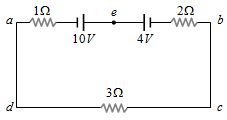
The magnitude and direction of the current in the circuit shown will be
|
(a) |
(b) |
|
(c) 1 A from b to a through e |
(d) 1 A from a to b through e |
The time period of a bar magnet suspended horizontally in the earth's magnetic field and allowed to oscillate
| (a) Is directly proportional to the square root of its mass |
| (b) Is directly proportional to its pole strength |
| (c) Is inversely proportional to its magnetic moment |
| (d) Decreases if the length increases but pole strength remains same |
A dip circle is at right angle to the magnetic meridian. What will be the apparent dip
| (a) 0° | (b) 30° | (c) 60° | (d) 90° |
An electron (mass = 9 × 10–31kg. Charge = 1.6 × 10⁻¹⁹C) whose kinetic energy is 7.2 × 10⁻¹⁸ joule is moving in a circular orbit in a magnetic field of 9 × 10⁻⁵ weber/m2. The radius of the orbit is
|
(a) 1.25 cm |
(b) 2.5 cm |
(c) 12.5 cm |
(d) 25.0 cm |
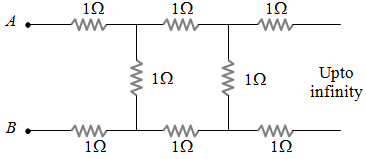
The resistance between the terminal points A and B of the given infinitely long circuit will be
|
(a) ( |
(b) (1 - |
(c) (1 + 
|
(d) (2 +
|
Two very thin metallic wires placed along X and Y-axis carry equal currents as shown here. AB and CD are lines at 45° with the axes with origin of axes at O. The magnetic field will be zero on the line

|
(a) AB |
(b) CD |
|
(c) Segment OB only of line AB |
(d) Segment OC only of line CD |


