MCQ
The ratio of the accelerations for a solid sphere (mass $m$ and radius $R$) rolling down an incline of angle $\theta$ without slipping and slipping down the incline without rolling is
  • $5:7$
  • B
    $2:3$
  • C
    $2:5$
  • D
    $7:5$

Answer

Correct option: A.
$5:7$
a
Acceleration of the solid sphere slipping down the incline without rolling is 

${a_{slipping}} = g\sin \theta \,\,\,\,\,\,\,...\left( i \right)$

Acceleration of the solid sphere rolling down the incline without slipping is

${a_{rolling}} = \frac{{g\sin \theta }}{{1 + \frac{{{k^2}}}{{{R^2}}}}} = \frac{{g\sin \theta }}{{1 + \frac{2}{5}}}$

$\left( {For\,solid\,sphere,\frac{{{k^2}}}{{{R^2}}} = \frac{2}{5}} \right)$

$= \frac{5}{7}g\sin \theta \,\,\,\,\,...\left( {ii} \right)$

Divide eqn. $(ii)$ by eqn. $(i)$, we get 

$\frac{{{a_{rolling}}}}{{{a_{slipping}}}} = \frac{5}{7}$

Need a full question paper?

Generate a complete, print-ready paper with questions like this in minutes — across 16+ boards, with answer keys.
Start Generating Free

Similar questions

The force on a particle as the function of displacement x (in $x-$ direction) is given by $F = 10 + 0.5x$ The work done corresponding to displacement of particle from $x = 0$ to $x = 2$ unit is
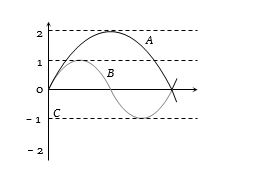
The displacement-time graphs for two sound waves $A$ and $B$ are shown in the figure, then the ratio of their intensities ${I_A}/{I_B}$ is equal to
The length of a seconds pendulum at a height $h=2 R$ from earth surface will be.(Given: $R =$ Radius of earth and acceleration due to gravity at the surface of earth $g =\pi^{2}\,m / s ^{-2}$ )
In Young’s double slit experiment the amplitudes of two sources are $3a$ and $a $ respectively. The ratio of intensities of bright and dark fringes will be
A charge $3$ coulomb experiences a force $3000$ $N$ when placed in a uniform electric field. The potential difference between two points separated by a distance of $1$ $cm$ along the field lines is.....$V$
The water equivalent of $20 \,g$ of aluminium (specific heat $0.2 \,cal ^{-1}{ }^{\circ} C ^{-1}$ ), is ......... $g$
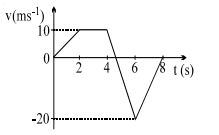
The figure shows a velocity-time graph of a particle moving along a straight line  The total distance travelled by the particle is  ........ $m$
The coefficient of apparent expansion of a liquid in a copper vessel is $C$ and in a silver vessel is $ S$. The coefficient of volume expansion of copper is $\gamma_c$. What is the coefficient of linear expansion of silver?
In a $PN-$ junction diode not connected to any circuit
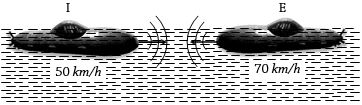
An Indian submarine and an enemy submarine move towards each other during maneuvers in motionless water in the Indian ocean. The Indian submarine moves at $50 km/h$, and the enemy submarine at $70 km/h$. The Indian sub sends out a sonar signal (sound wave in water) at $1000 Hz$. Sonar waves travel at $5500 km/h$. What is the frequency detected by the Indian submarine .... $kHz$