MCQ
The ratio of the radius of the earth to that of the moon is $10$. The ratio of acceleration due to gravity on the earth and on the moon is $6$. The ratio of the escape velocity from the earth's surface to that from the moon is
  • A
    $10$
  • B
    $6$
  • Nearly $8$
  • D
    $1.66$

Answer

Correct option: C.
Nearly $8$
c
(c) $\frac{{{v_{\rm{e}}}{\rm{ }}}}{{{v_m}}} = \sqrt {\frac{{{g_e}}}{{{g_m}}}\;\frac{{{R_e}}}{{{R_m}}}} $=$\sqrt {6 \times 10} $$ = \sqrt {60} \cong 8\;{\rm{(nearly)}}$

Need a full question paper?

Generate a complete, print-ready paper with questions like this in minutes — across 16+ boards, with answer keys.

Start Generating Free

Similar questions

The electric field in a region is directed outward and is proportional to the distance $r$ from the origin. Taking the electric potential at the origin to be zero,
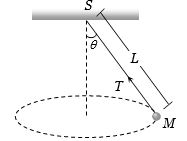
A string of length $L$ is fixed at one end and carries a mass $M$ at the other end. The string makes $2/\pi$ revolutions per second around the vertical axis through the fixed end as shown in the figure, then tension in the string is
A car is moving with a velocity of $30\ ms^{-1}$. On applying the brakes, the velocity decreases to $15\ ms^{-1}$ in $2s.$ The acceleration of the car is:
A bullet when fired at a target with a velocity of $100\,\,m/sec$ penetrates one metre into it. If the bullet is fired at a similar target with a thickness $0.5\,\,metre,$  then it will emerge from it with a velocity of
A cubical block is floating in a liquid with one fourth of its volume immersed in the liquid. If whole of the system accelerates upward with acceleration $g / 4$, the fraction of volume immersed in the liquid will be ..........
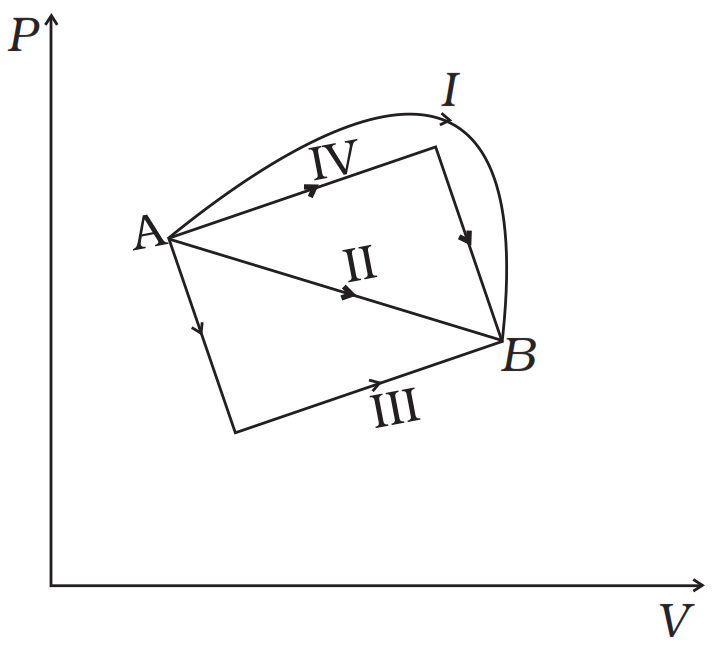
Figure. shows the $P-V$ diagram of an ideal gas undergoing a change of state from $A$ to $B$. Four different parts $\text{I, II, III}$ and $\text{IV}$ as shown in the figure may lead to the same change of state.

 
The position vector of a particle is $\vec r = (a\cos \omega t)\hat i + (a\sin \omega t)\hat j$. The velocity of the particle is
A person aiming to reach the exactly opposite point on the bank of a stream is swimming with a speed of $0.5\, m/s$ at an angle of $120^°$ with the direction of flow of water. The speed of water in the stream is..........$m/s$
Escape velocity of a body of $1\, kg$ mass on a planet is $100 \,m/sec$. Gravitational Potential energy of the body at the Planet is ......... $J$.
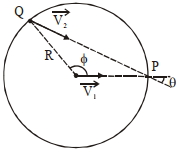
Two particles, one at the centre of a circle of radius $R$, and another at a point $Q$ on the circle, start moving towards a point $P$ on the circle at the same time (see figure below). Both are at rest initially and move with uniform velocities $\vec{V}_1$ and $\overrightarrow{V_2}$ respectively. They also reach the point $P$ at the same time, If the angle between the velocities is $\theta$ and the angle subtended by $P$ and $Q$ at the centre is $\phi$ (as shown in the figure), then