MCQ
The ratio of the speed of a projectile at the point of projection to the speed at the top of its trajectory is $x$. The angle of projection with the horizontal is
  • A
    $\sin ^{-1}(x)$
  • B
    $\cos ^{-1}(x)$
  • C
    $\sin ^{-1}(1 / x)$
  • $\cos ^{-1}(1 / x)$

Answer

Correct option: D.
$\cos ^{-1}(1 / x)$
d
(d)

$\frac{u}{u \cos \theta}=x \operatorname{or} \cos \theta=\frac{1}{x} \Rightarrow \therefore \quad \theta=\cos ^{-1}\left(\frac{1}{x}\right)$

Need a full question paper?

Generate a complete, print-ready paper with questions like this in minutes — across 16+ boards, with answer keys.
Start Generating Free

Similar questions

A wooden block floating in a bucket of water has $\frac{4}{5}$ of its volume submerged. When certain amount of an oil is poured into the bucket, it is found that the block is just under the oil surface with half of its volume under water and half in oil. The density of oil relative to that of water is
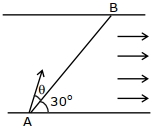
A swimmer wants to cross a river from point $A$ to point $B$. Line $A B$ makes an angle of $30^{\circ}$ with the flow of river. Magnitude of velocity of the swimmer is same as that of the river. The angle $\theta$ with the line ${AB}$ should be $^{\circ}$, so that the swimmer reaches point ${B}$.
Electromagnetic waves are produced by:
A ring is rolling on an inclined plane. The ratio of the linear and rotational kinetic energies will be
A man weighs $80\,kg.$ He stands on a weighing scale in a lift which is moving upwards with a uniform acceleration of $5m/{s^2}.$ What would be the reading on the scale. $(g = 10m/{s^2})$  ............ $N$
A body of mass $0.4\, kg$ is whirled in a vertical circle making $2\, rev/sec$. If the radius of the circle is $2\, m$, then tension in the string when the body is at the top of the circle, is ......... $N$
Which of the following statements is correct?
A bubble has surface tension $S$. The ideal gas inside the bubble has ratio of specific heats $\gamma=\frac{5}{3}$. The bubble is exposed to the atmosphere and it always retains its spherical shape. When the atmospheric pressure is $P_{a 1}$, the radius of the bubble is found to be $r_1$ and the temperature of the enclosed gas is $T_1$. When the atmospheric pressure is $P_{a 2}$, the radius of the bubble and the temperature of the enclosed gas are $r_2$ and $T_2$, respectively.

Which of the following statement($s$) is(are) correct?

$(A)$ If the surface of the bubble is a perfect heat insulator, then $\left(\frac{r_1}{r_2}\right)^5=\frac{P_{a 2}+\frac{2 S}{r_2}}{P_{a 1}+\frac{2 S}{r_1}}$

$(B)$ If the surface of the bubble is a perfect heat insulator, then the total internal energy of the bubble including its surface energy does not change with the external atmospheric pressure.

$(C)$ If the surface of the bubble is a perfect heat conductor and the change in atmospheric temperature is negligible, then $\left(\frac{r_1}{r_2}\right)^3=\frac{P_{a 2}+\frac{4 S}{r_2}}{P_{a 1}+\frac{4 S}{r_1}}$.

$(D)$ If the surface of the bubble is a perfect heat insulator, then $\left(\frac{T_2}{T_1}\right)^{\frac{5}{2}}=\frac{P_{a 2}+\frac{4 S}{r_2}}{P_{a 1}+\frac{4 S}{r_1}}$.
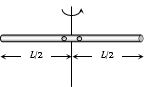
A smooth uniform rod of length $L$ and mass $M$ has two identical beads of negligible size, each of mass $m$, which can slide freely along the rod. Initially the two beads are at the centre of the rod and the system is rotating with angular velocity ${\omega _0}$ about an axis perpendicular to the rod and passing through the mid point of the rod (see figure). There are no external forces. When the beads reach the ends of the rod, the angular velocity of the system is
A mass $M$, attached to a horizontal spring, executes S.H.M. with amplitude $A_1$. When the mass $M$ passes through its mean position then a smaller mass $m$ is placed over it and both of them move together with amplitude $A_2$. The ratio of $\frac{{{A_1}}}{{{A_2}}}$ is