MCQ
The ratio of the speed of sound in nitrogen gas to that in helium gas, at $300 K$ is
  • A
    $\sqrt {2/7} $
  • B
    $\sqrt {1/7} $
  • $\sqrt 3 /5$
  • D
    $\sqrt 6 /5$

Answer

Correct option: C.
$\sqrt 3 /5$
c
(c) Velocity of sound in gas $v = \sqrt {\frac{{\gamma RT}}{M}} $

==> $v \propto \sqrt {\frac{{\gamma T}}{M}} $ 

==>$\frac{{{v_{{N_2}}}}}{{{v_{He}}}} = \sqrt {\frac{{{\gamma _{{N_2}}}}}{{{\gamma _{He}}}} \times \frac{{{M_{He}}}}{{{M_{{H_2}}}}}} = \sqrt {\frac{{\frac{7}{5}R \times 4}}{{\frac{5}{3}R \times 28}}} = \frac{{\sqrt 3 }}{5}$

Need a full question paper?

Generate a complete, print-ready paper with questions like this in minutes — across 16+ boards, with answer keys.
Start Generating Free

Similar questions

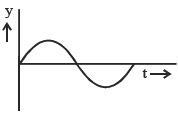
The displacement versus time graph of $SHM$ is Which of the following is its acceleration versus time graph ?
An electric dipole is placed in a uniform electric field. The net electric force on the dipole.
A transverse wave propagating along $x-$ axis is represented by $y (x,t)= 8.0 sin$ $\left( {0.5\pi x - 4\pi t - \frac{\pi }{4}} \right)$ where $x$ is in metres and $t$ is in seconds. The speed of the wave is ..... $m/s$
The excess pressure due to surface tension in a spherical liquid drop of radius r is directly proportional to
Two bodies of mass $3\, kg$ and $4\, kg$ are suspended at the ends of massless string passing over a frictionless pulley. The acceleration of the system is ........ $m/{s^2}$  $(g = 9.8\,m/{s^2})$ 
A butterfly is flying with a velocity $4 \sqrt{2} \,{m} / {s}$ in North-East direction. Wind is slowly blowing at $1$ ${m} / {s}$ from North to South. The resultant displacement of the butterfly in $3\, seconds$ is $....\,{m}.$
Water is poured from a height of $10m$ into an empty barrel at the rate of $1$litre per second. If the weight of the barrel is $10\ kg,$ the weight indicated at time $t = 60s$ will be:
Two equal masses $m$ and $m$ are hung from a balance whose scale pans differ in vertical height by $'h'$. The error in weighing in terms of density of the earth $\rho $ is
A particle moves from $x=0$ to $x=x_1$ under the influence of force $F =-k x$. The work done in this will be :
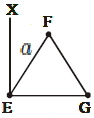
An massless equilateral triangle $EFG$ of side $'a'$ (As shown in figure) has three particles of mass $m$ situated at its vertices. The moment of intertia of the system about the line $EX$ perpendicular to $EG$ in the plane of $EFG$ is $\frac{ N }{20}\, ma ^{2}$ where $N$ is an integer. The value of $N$ is