MCQ
The rays of different colours fail to converge at a point after going through a converging lens. This defect is called:
  • A
    Spherical aberration.
  • B
    Distortion.
  • C
    Coma.
  • Chromatic aberration.

Answer

Correct option: D.
Chromatic aberration.
Explanation:
The rays of different colours fail to converge at a Point after going through a converging Lens. This defect is called chromatic oberration.

Need a full question paper?

Generate a complete, print-ready paper with questions like this in minutes — across 16+ boards, with answer keys.
Start Generating Free

Similar questions

The lateral displacement depends on $.........$
For total internal reflection to take place, the angle of incidence $i$ and the refractive index $\mu $ of the medium must satisfy the inequality
A fish looking up through the water sees the outside world contained in a circular horizon. If the refractive index of water is $\frac{4}{3}$ and the fish is $12 \ cm$ below the surface, the radius of this circle in cm is
A $50\,\Omega $ resistance is connected to a battery of $5\,V$.  A galvanometer of resistance $100\, \Omega $ is to be used as an ammeter to measure current through the resistance, for this a resistance $r_s$ is connected to the galvanometer. Which of the following connections should be employed if the measured current is within $1\% $ of the current without the ammeter in the circuit ?
A rectangular coil of $300$ turns has an average area of average area of $25\;cm \times 10\;cm.$ The coil rotates with a speed of $50$ cps in a uniform magnetic field of strength $4 \times {10^{ - 2}}T$ about an axis perpendicular of the field. The peak value of the induced $e.m.f$. is (in volt)
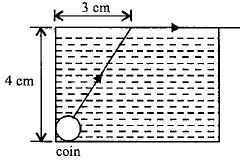
A small coin is resting on the bottom of a beaker filled with liquid. A ray of light from the coin travels upto the surface of the liquid and moves along its surface. How fast is the light travelling in the liquid? 
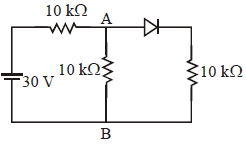
In the figure, potential difference between $A$ and $B$ is......$V$
The angular velocity of the engine (and hence of the wheel) of a scooter is proportional to the petrol input per second. The scooter is moving on a frictionless road with uniform velocity. If the petrol input is increased by 10%, the linear velocity of the scooter is increased by:
$1^{ H ^1}+1^{ H ^1}+1^{ H ^2} \rightarrow X +-1^{ e ^0}+$energy. The emitted particle is
Seven capacitors, each of the capacitance $2\,\mu F$, are to be connected in a configuration to obtain an effective capacitance of $\left( {\frac{6}{{13}}} \right)\,\mu F$. Which of the combinations, shown in figures below, will achieve the desired value ?