Question
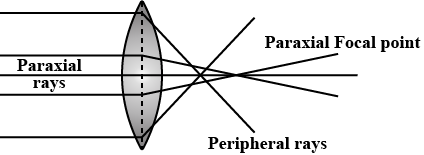
The rays parallel and close to the principal axis are called:

Answer

  1. Paraxial rays
Explanation:
The rays parallel and close to the principal axis are called paraxial rays. The rays parallel but not close to the principal axis are called peripheral rays.

Need a full question paper?

Generate a complete, print-ready paper with questions like this in minutes — across 16+ boards, with answer keys.
Start Generating Free

Similar questions

The focal length of objective and eye lens of a microscope are 4 cm and 8 cm respectively. If the least distance of distinct vision is 24 cm and object distance is 4.5 cm from the objective lens, then the magnifying power of the microscope will be(a) 18(b) 32 (c) 64 (d) 20  
       
Two coherent sources have intensity in the ratio of $\frac{100}{1}$ . Ratio of $($intensity$)$ max$($intensity$)$ min is
When electron beam passes through an electric field, they gain kinetic energy. If the same beam passes through magnetic field, then(a) Their energy increases(b) Their momentum increases (c) Their potential energy increases(d) Energy and momentum both remains unchanged


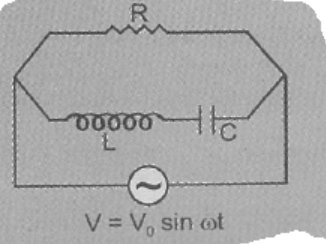
The Current in resistance $R$ at resonance is.
Image
The reason of current flow in P-N junction in forward bias is(a) Drifting of charge carriers(b) Minority charge carriers(c) Diffusion of charge carriers(d) All of these
   
   
If the focal length of a double convex lens for red light is $\mathrm{S}_{\mathrm{R}}$ its focal length for the violet light is
An oil flowing on water seems coloured due to interference. For observing this effect, the approximate thickness of the oil film should be(a) 100 Å(b) 10000 Å(c) 1 mm(d) 1 cm
       
Assertion :  The stars twinkle while the planets do not.
Reason    : The stars are much bigger in size than the planets.(a) If both assertion and reason are true and the reason is the correct explanation of the assertion.(b) If both assertion and reason are true but reason is not the correct explanation of the assertion.(c) If assertion is true but reason is false.(d) If the assertion and reason both are false.


A plane electromagnetic wave propagating along $x$ direction can have the following pairs of $E$ and $B.$
The direction of electric field is from: