MCQ
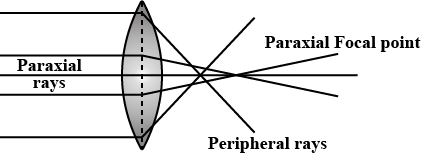
The rays parallel and close to the principal axis are called:
  • A
    Converging rays
  • B
    Diverging rays
  • C
    Coherent rays
  • Paraxial rays

Answer

Correct option: D.
Paraxial rays

The rays parallel and close to the principal axis are called paraxial rays. The rays parallel but not close to the principal axis are called peripheral rays.
Need a full question paper?

Generate a complete, print-ready paper with questions like this in minutes — across 16+ boards, with answer keys.
Start Generating Free

Similar questions

Deviation of 5° is observed from a prism whose angle is small and whose refractive index is 1.5. The angle of prism is
Among the following $.......$ has the highest retentivity.
Two positive ions, each carrying a charge $q,$ are separated by a distance $d.$ If $F$ is the force of repulsion between the ions, the number of electrons missing from each ion will be  ($e$ being the charge on an electron)
In the Young's double slit experiment, the spacing between two slits is 0.1 mm. If the screen is kept at a distance of 1.0 m from the slits and the wavelength of light is 5000 Å, then the fringe width is
When a dielectric material is introduced between the plates of a charged condenser then electric field between the plates
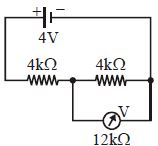
The percentage error in the reading of the voltmeter in the figure shown here is nearly ............ $\%$
A radioactive sample of $U^{238}$ decay to $Pb$ through a process for which half life is $4.5 × 10^9$ years. The ratio of number of nuclei of $Pb$ to $U^{238}$ after a time of $1.5 ×10^9$ years (given $2^{1/3} = 1.26$)
A conducting sphere of radius $10 \;cm$ has an unknown charge. If the electric field $20\; cm$ from the centre of the sphere is $1.5 \times 10^{3} \;N / C$ and points radially inward, what is the net charge (in $n\;C$) on the sphere?
Two samples $A$ and $B$ are initially kept in the same state. Sample $A$ is expanded through an adiabatic process and the sample $B$ through an isothermal process. The final volumes of the samples are the same. The final pressures in $A$ and $B$ are $p_A$ and $p_B$ respectively.
A coil has $100$ turns. When a current of $5A$ produces a magnetic flux of $1\mu\text{Wb}$, the coefficient of self induction is :