MCQ
The reactance of a circuit is zero. It is possible that the circuit contains.
  • A
    an inductor and a capacitor
  • B
    an inductor but no capacitor
  • C
    a capacitor but no inductor
  • neither an inductor nor a capacitor

Answer

Correct option: D.
neither an inductor nor a capacitor

Answer: $A$ an inductor and a capacitor, $B$ neither an inductor nor a capacitor
Reactance in electrical and electronic systems is the opposition of a circuit element to a change of electric current or voltage.Ideally a resistor has zero reactance.
Therefore in a circuit, reactance can be zero either if there are no inductors and capacitors in the circuit, or the individual reactance of inductors and capacitors cancel each other, making net reactance zero.

Need a full question paper?

Generate a complete, print-ready paper with questions like this in minutes — across 16+ boards, with answer keys.

Start Generating Free

Similar questions

The frequency of $A.C$ mains in India is.
Four light waves are represented by

(i) $y = a_1\, sin\omega\, t$ 

(ii) $y = {a_2}\sin (\omega \,t + \phi )$

(iii) $y = {a_1}\sin 2\omega \,t$         

(iv) $y = {a_2}\sin 2(\,\omega \,t + \phi )$

Interference fringes may be observed due to superposition of
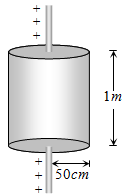
Electric charge is uniformly distributed along a long straight wire of radius 1mm. The charge per cm length of the wire is Q coulomb. Another cylindrical surface of radius 50 cm and length 1m symmetrically encloses the wire as shown in the figure. The total electric flux passing through the cylindrical surface is
An Aluminium $(Al)$ rod with area of cross-section $4 \times 10^{-6} m^2$ has a current of $5$ ampere. Flowing through it. Find the drift velocity of electron in the rod. Density of $AI =2.7 \times 10^3 kg / m ^3$ and Atomic wt. $=27$. Assume that each AI atom provides one electron:
Free $^{238}U$ nuclei kept in a train emit alpha particles. When the train is stationary and a uranium nucleus decays, a passenger measures that the separation between the alpha particle and the recoiling nucleus becomes $x$ in time $t$ after the decay. If a decay takes place when the train is moving at a uniform speed $v$, the distance between the alpha particle and the recoiling nucleus at a time $t$ after the decay, as measured by the passenger will be:
A current carrying infinitely long wire is kept along the diameter of a circular wire loop, without touching it. The correct statement $(s)$ is (are) :

$(A)$ the emf induced in the loop is zero if the current is constant.

$(B)$ The emf induced in the loop is finite if the current is constant.

$(C)$ The emf induced in the loop is zero if the current decreases at a steady rate.

$(D)$ Theemf induced in the loop is finite if the current decreases at a steady rate.

The electron in a hydrogen atom first jumps from the third excited state to the second excited state and subsequently to the first excited state. The ratio of the respective wavelengths, $\lambda _1/\lambda _2$, of the photons emitted in this process is
The positive terminal of $12V$ battery is connected to the ground. Then the negative terminal will be at:
If two charges of $1$ coulomb each are placed $1\ km$ apart in vacuum, the force between them will be:
A proton and an electron are placed in a uniform electric field.