MCQ
the reactant $(A)$ will be
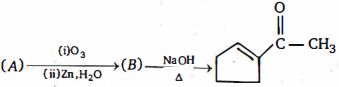
  • B

  • C

  • D

Answer

Correct option: A.

a
$(a)$ In presence of $NaOH$ intramolecular aldol condensation take place.

Need a full question paper?

Generate a complete, print-ready paper with questions like this in minutes — across 16+ boards, with answer keys.

Start Generating Free

Similar questions

Two identical charged spherical drops each of capacitance $C$ merge to form a single drop. The resultant capacitance is
A step-down transformer is connected to $2400 \,volts$ line and $80$ amperes of current is found to flow in output load. The ratio of the turns in primary and secondary coil is $20 : 1$. If transformer efficiency is $100\%$, then the current flowing in primary coil will be.....$A$
In a Young's double slit experiment, the slits are $2 \,mm$ apart and are illuminated with a mixture of two wavelength ${\lambda _0} = 750\,nm$ and $\lambda = 900\,nm$. The minimum distance from the common central bright fringe on a screen $2\,m$ from the slits where a bright fringe from one interference pattern coincides with a bright fringe from the other is.....$mm$
Minimum thickness of a mica sheet having $\mu = \frac{3}{2}$ which shoule be placed in front of one of the slits in $YDSE$ is required to reduce the intensity at the centre of screen to half of maximum intensity is
The binding energy of deuteron $_1^2H$ is $1.112\, MeV$ per nucleon and an $\alpha -$ Particle $_2^4He$ has a binding energy of $7. 047\, MeV$ per nucleon. Then in the fusion reaction $_1^2H + _1^2H \to _2^4He + Q,$ the energy $Q$ released is ........ $MeV$
If a lens is moved towards the object from a distance of $40 \,cm$ to $30 \,cm$, the magnification of the image remains the same (numarically). The focal length of the lens is ......... $cm$
The electric potential varies in space according to the relation $V = 3x + 4y$. A particle of mass $0.1\,\, kg$ starts from rest from point $(2, 3·2)$ under the influence of this field. The charge on the particle is $+1\,\, μC$. Assume $V$ and $(x, y)$ are in $S.I.$ $units$ . The time taken to cross the $x-$ axis is.....$s$
A particle of mass $'\mathrm{m}'$ is projected with a velocity $v=\mathrm{kV}_{\mathrm{e}}(\mathrm{k}\,<\,1)$ from the surface of the earth.

$\left(\mathrm{V}_{\mathrm{e}}=\right.\text { escape velocity) }$

The maximum height above the surface reached by the particle is :

The curve between the activity $A$ of a radioactive sample and the number of active atoms $N$ is
A body of mass $1\, kg$ rests on a horizontal floor with which it has a coefficient of static friction $\frac{1}{\sqrt{3}}$. It is desired to make the body move by applying the minimum possible force $F\, N$. The value of $F$ will be the Nearest Integer) [Take $g =10 \,ms ^{-2}$ ]