MCQ
The reaction $2 A + B _{2} \rightarrow 2 AB$ is an elementary reaction.

For a certain quantity of reactants, if the volume of the reaction vessel is reduced by a factor of $3,$ the rate of the reaction increases by a factor of $.....$. (Round off to the Nearest Integer).

  • $27$
  • B
    $37$
  • C
    $47$
  • D
    $57$

Answer

Correct option: A.
$27$
a
Reaction : $2 A + B _{2} \longrightarrow 2 AB$

As the reaction is elementary, the rate of reaction is $r = K \cdot[ A ]^{2}\left[ B _{2}\right]$

on reducing the volume by a factor of $3,$ the concentrations of $A$ and $B _{2}$ will become $3$ times and hence, the rate becomes $3^{2} \times 3=27$ times of initial rate.

Need a full question paper?

Generate a complete, print-ready paper with questions like this in minutes — across 16+ boards, with answer keys.

Start Generating Free

Similar questions

If $\Delta_fG^o [X (l)] = -65\,\, kcal\,\, mol^{-1}$ and $\Delta_fG^o \,[X (g)] = -60.4 \,\, kcal\,\, mol^{-1},$ the vapour pressure of water at $500\,\,K$ would be about ......$atm$

$ Given\, :\, lna = 2.3\, loga$

The energies $E_1$ and $E_2$ of two radiations are $25\, eV$ and $50\, eV$ respectively. The relation between their wavelengths i.e., ${\lambda _1}$ and ${\lambda _2}$will be
When $0.1\, mol$ $CoCl_3(NH_3)_5$ is treated with excess of $AgNO_3$, $0.2\, mol$ of $AgCl$ are obtained. Then compound is...
Number of $\pi $ bonds in $C{H_2} = CH - CH = CH - C \equiv CH$ is
For the reaction $A + 2B$ $\rightleftharpoons$ $C$, the expression for equilibrium constant is
The number of $sp^2$ hybridised carbons present in "Aspartame" is
The solubility of $Ba_3(AsO_4)_2$ (molar mass $= 690$) is $6.9 \times 10^{-2} \,g/100\, mL$. What is the value of its $K_{sp}$?
The number of moles of sodium oxide in $620\,g$ of it is ................ $\mathrm{moles}$
Equimolar solutions of the following substances were prepared separately. Which one of these will record the highest $pH$ value?
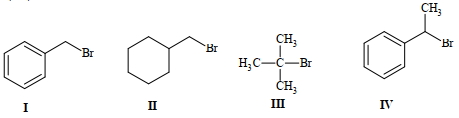
For the following compounds, the correct statement(s) with respect to nucleophilic substitution reactions is(are)

(IMAGE)

$[A]$ $I$ and $III$ follow $\mathrm{S}_{\mathrm{N}} 1$ mechanism

$[B]$ $I$ and $II$ follow $\mathrm{S}_{\mathrm{N}} 2$ mechanism

$[C]$ Compound $IV$ undergoes inversion of configuration

$[D]$ The order of reactivity for $I$, $III$ and $IV$ is: $IV$ $>$ $I$ $>$ $III$