For a certain quantity of reactants, if the volume of the reaction vessel is reduced by a factor of $3,$ the rate of the reaction increases by a factor of $.....$. (Round off to the Nearest Integer).
- ✓$27$
- B$37$
- C$47$
- D$57$
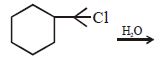
For a certain quantity of reactants, if the volume of the reaction vessel is reduced by a factor of $3,$ the rate of the reaction increases by a factor of $.....$. (Round off to the Nearest Integer).
As the reaction is elementary, the rate of reaction is $r = K \cdot[ A ]^{2}\left[ B _{2}\right]$
on reducing the volume by a factor of $3,$ the concentrations of $A$ and $B _{2}$ will become $3$ times and hence, the rate becomes $3^{2} \times 3=27$ times of initial rate.
Generate a complete, print-ready paper with questions like this in minutes — across 16+ boards, with answer keys.
(Given that $K_f = 5\,K\, kg\,mol^{-1},$ Molar mass of benzoic acid $= 122\,g\,mol^{-1}$ )

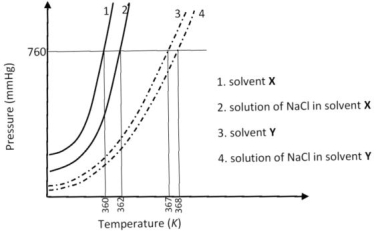
On addition of equal number of moles of a non-volatile solute $S$ in equal amount (in $kg$ ) of these solvents, the elevation of boiling point of solvent $X$ is three times that of solvent $Y$. Solute $S$ is known to undergo dimerization in these solvents. If the degree of dimerization is $0.7$ in solvent $Y$, the degree of dimerization in solvent $X$ is. . . . . . .