MCQ
The reaction, $(CH_3)_2C = CH_2 + B{{r}^{\centerdot }} \to (CH_3)_2 \overset{\centerdot }{\mathop{C}}\,- CH_2Br$

is an example of a/an ................ step in a radical chain reaction.

  • A
    initiation
  • B
    termination
  • propagation
  • D
    heterolytic cleavage

Answer

Correct option: C.
propagation
c
$(c)$ Attack of free radical on alkene is an propagation step.

Need a full question paper?

Generate a complete, print-ready paper with questions like this in minutes — across 16+ boards, with answer keys.

Start Generating Free

Similar questions

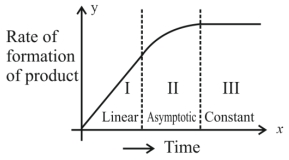
For certain chemical reaction $X \rightarrow Y$, the rate of formation of product is plotted against the time as shown in the figure. The number of Correct statement/s from the following is $.......$.

$(A)$ Over all order of this reaction is one

$(B)$ Order of this reaction can't be determined

$(C)$ In region$-I$ and $III$, the reaction is of first and zero order respectively

$(D)$ In region$-II$, the reaction is of first order

$(E)$ In region$-II$, the order of reaction is in the range of $0.1$ to $0.9$.

The $H-$ bonds in solid $HF$ can be best represented as
The dipole moment is the highest for
What is the correct order of $o/ p$ ratio when $E^+$ attacks the following system  ?

$\underset{A}{\mathop{PhF}}\,\,\,\,\,\,\,\,\,\,\,\,\,\,\,\,\,\underset{B}{\mathop{PhCl}}\,\,\,\,\,\,\,\,\,\,\,\,\,\,\,\,\,\,\,\underset{C}{\mathop{PhBr}}\,\,\,\,\,\,\,\,\,\,\,\,\,\,\,\underset{D}{\mathop{PhI}}\,$

The correct $I U P A C$ name of the given compound is
Which of the following processes takes place with decrease of entropy?
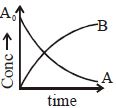
For the reaction, $A \to nB$. At the point of intersection of the two curves, the concentration of $B$ is given by .....
Which one of the following pairs of species have the same bond order ?
$(A)$ $HOCl + H _{2} O _{2} \rightarrow H _{3} O ^{+}+ Cl ^{-}+ O _{2}$

$(B)$ $I _{2}+ H _{2} O _{2}+2 OH ^{-} \rightarrow 2 I ^{-}+2 H _{2} O + O _{2}$

Choose the correct option.

$STATEMENT-1$: Bromobenzene upon reaction with $\mathrm{Br}_2 / \mathrm{Fe}$ gives $1,4$ -dibromobenzene as the major product. and

$STATEMENT-2$: In bromobenzene, the inductive effect of the bromo group is more dominant than the mesomeric effect in directing the incoming electrophile.