MCQ
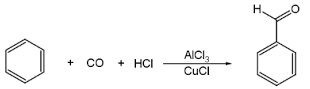
The reagent used in Gatterman Koch aldehyde synthesis is
- A$Pb/BaS{O_4}$
- Balkaline $KMn{O_4}$
- Cacidic $KMn{O_4}$
- ✓$CO + HCl$
Generate a complete, print-ready paper with questions like this in minutes — across 16+ boards, with answer keys.
| Observation | $[A]$ | $[B]$ | Rate of reaction |
| $1$ | $0.1$ | $0.1$ | $2 \times {10^{ - 3}}\,mol\,{L^{ - 1}}{\sec ^{ - 1}}$ |
| $2$ | $0.4$ | $0.1$ | $0.4 \times {10^{ - 2}}\,mol\,{L^{ - 1}}{\sec ^{ - 1}}$ |
| $3$ | $0.1$ | $0.2$ | $1.4 \times {10^{ - 2}}\,mol\,{L^{ - 1}}{\sec ^{ - 1}}$ |
| Reaction | Product | |
| $I$ | $RX + AgCN$ | $RNC$ |
| $II$ | $RX + KCN$ | $RCN$ |
| $III$ | $RX + KNO_2$ | (image) |
| $IV$ | $RX + AgNO_2$ | $R-O-N = O$ |

$(1)$ Oxidation of glucose with bromine water gives glutamic acid
$(2)$ The two six-membered cyclic hemiacetal forms of $D-(+)$-glucose ard called anomers
$(3)$ Hydrolysis of sucrose gives dextrorotatory glucose and laevorotatory fructose
$(4)$ Monosaccharides cannot be hydrolysed to give polyhydroxy aldehydes and ketones