Question
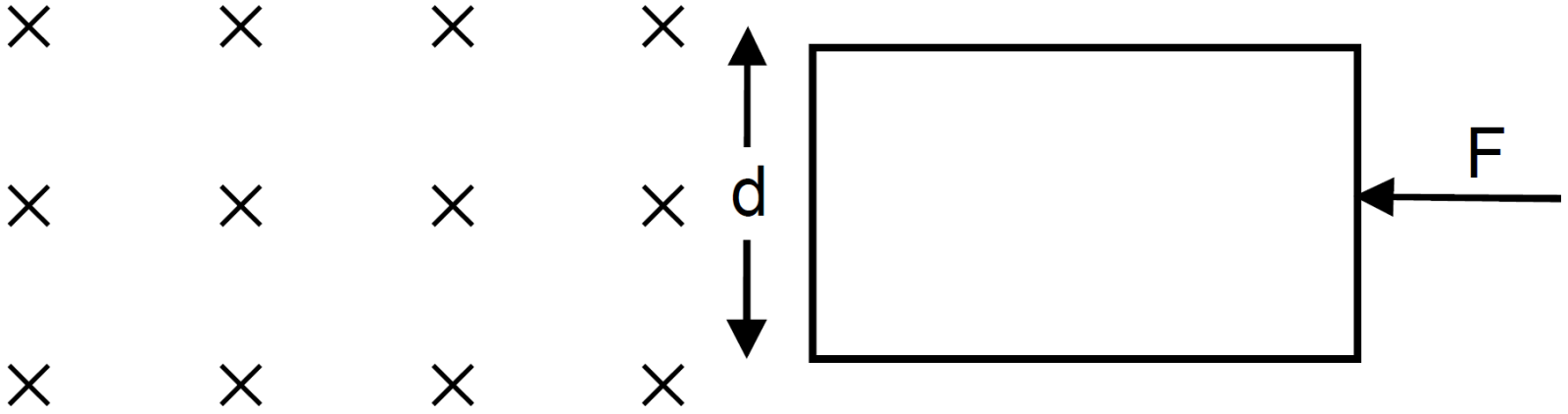
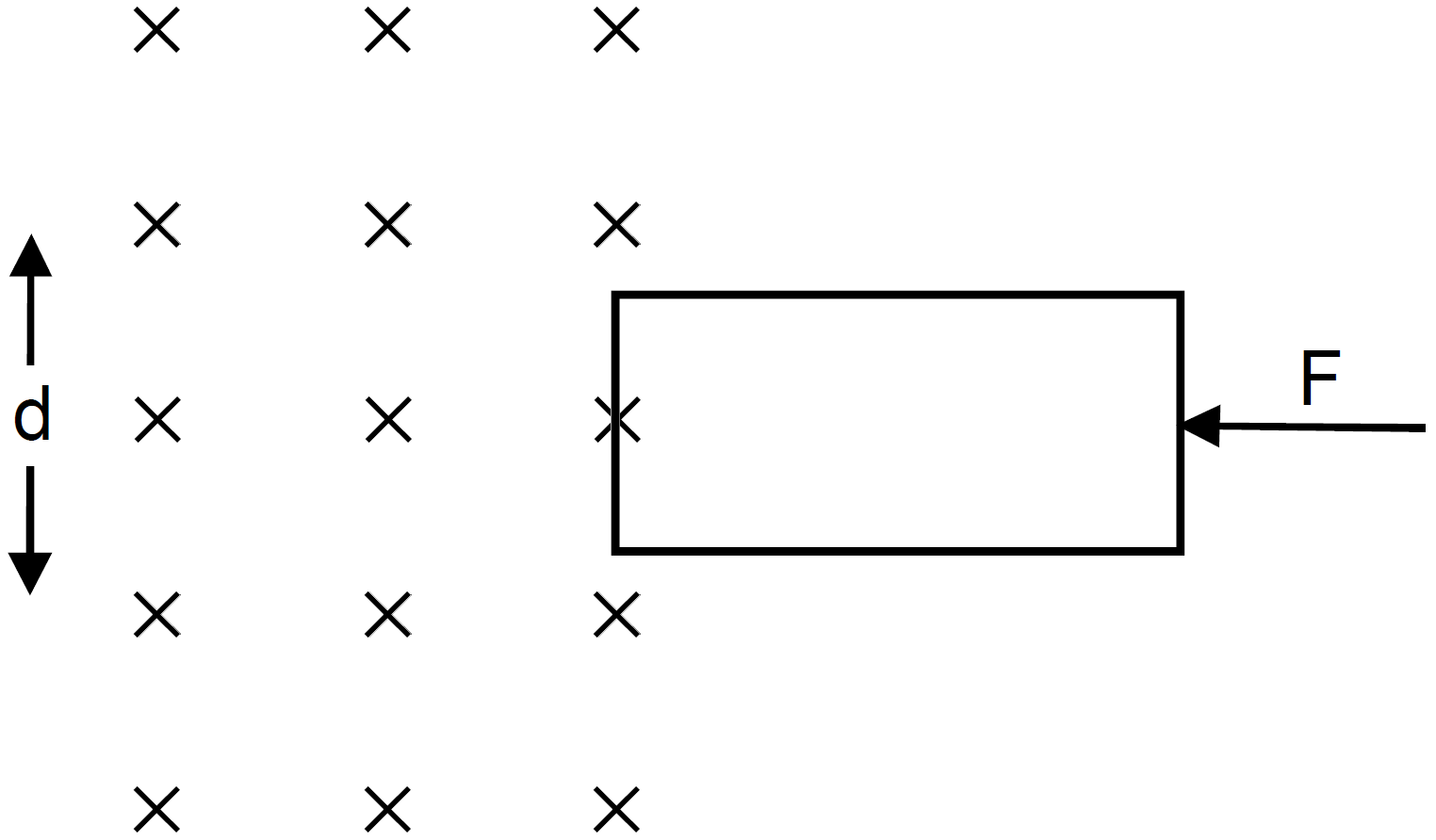
The rectangular wire-frame, shown in figure, has a width d, mass m, resistance R and a large length. A uniform magnetic field B exists to the left of the frame. A constant force F starts pushing the frame into the magnetic field at t = 0.

  1. Find the acceleration of the frame when its speed has increased to v.
  2. Show that after some time the frame will move with a constant velocity till the whole frame enters into the magnetic field. Find this velocity v0.
  3. Show that the velocity at time t is given by $\text{v}=\text{v}_0\Big(1-\text{e}^{-\frac{\text{ft}}{\text{mv}_0}}\Big)$
Answer

  1. emf developed = Bdv (when it attains a speed v)

Current $=\frac{\text{Bdv}}{\text{R}}$

Force $=\frac{\text{B}\text{d}^2\text{v}^2}{\text{R}}$

This force opposes the given force

Net F $=\text{F}-\frac{\text{B}\text{d}^2\text{v}^2}{\text{R}}=\text{RF}-\frac{\text{B}\text{d}^2\text{v}^2}{\text{R}}$

Net acceleration $=\frac{\text{RF}-\text{B}^2\text{d}^2\text{v}}{\text{mR}}$

  1. Velocity becomes constant when acceleration is 0.

$\frac{\text{F}}{\text{m}}-\frac{\text{B}^2\text{d}^2\text{v}_0}{\text{mR}}=0$

$\Rightarrow\frac{\text{F}}{\text{m}}=\frac{\text{B}^2\text{d}^2\text{v}_0}{\text{mR}}$

$\Rightarrow\text{v}_0=\frac{\text{FR}}{\text{B}^2\text{d}^2}$

  1. Velocity at line t

$\text{a}=-\frac{\text{dv}}{\text{dt}}$

$\Rightarrow\int_{0}^{\text{v}}\frac{\text{dv}}{\text{RF}-\text{l}^2\text{B}^2\text{v}}=\int_{0}^{\text{t}}\frac{\text{dt}}{\text{mR}}$

$\Rightarrow\Big[\text{l}_\text{n}\big[\text{RF}-\text{l}^2\text{B}^2\text{v}\big]\frac{1}{-\text{l}^2\text{B}^2}\Big]_0^{\text{v}} \ \Big[\frac{\text{t}}{\text{Rm}}\Big]_0^{\text{t}} $

$\Rightarrow\Big[\text{l}_\text{n}\big(\text{RF}-\text{l}^2\text{B}^2\text{v}\big)\Big]_{0}^{\text{v}}=\frac{-\text{tl}^2\text{B}^2}{\text{Rm}}$

$\Rightarrow\text{l}_\text{n}\big(\text{RF}-\text{l}^2\text{B}^2\text{v}\big)-\text{ln}(\text{RF})=\frac{-\text{t}^2\text{B}^2\text{t}}{\text{Rm}}$

$\Rightarrow1-\frac{\text{l}^2\text{B}^2\text{v}}{\text{Rf}}=\text{e}^{\frac {-\text{l}^2\text{B}^2\text{t}}{\text{Rm}}}$

$\Rightarrow\frac{\text{l}^2\text{B}^2\text{v}}{\text{Rf}}=1-\text{e}^{\frac {-\text{l}^2\text{B}^2\text{t}}{\text{Rm}}}$

$\Rightarrow\text{v}=\frac{\text{FR}}{\text{l}^2\text{B}^2}\Big(1-\text{e}^{\frac{-\text{l}^2\text{B}^2\text{v}_0\text{t}}{\text{Rv}_0\text{m}}}\Big)=\text{v}_0(1-\text{e}^{-\text{Fv}_0\text{m}})$

Need a full question paper?

Generate a complete, print-ready paper with questions like this in minutes — across 16+ boards, with answer keys.

Start Generating Free

Similar questions

A circular disc made of iron is rotated about its axis at a constant velocity to $\omega$. Calculate the percentage change in the linear speed of a particle of the rim as the disc is slowly heated from 20°c to 50°C keeping the angular velocity constant. Coefficient of linear expansion of iron = 1.2 × 10⁻⁵ °C-1.
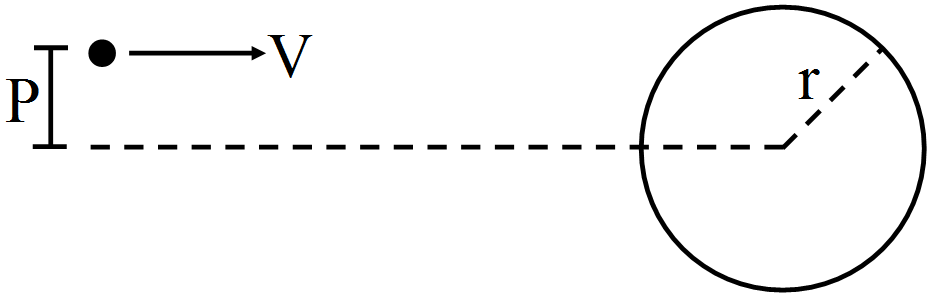
A small particle travelling with a velocity u collides elastically with a spherical body of equal mass and of radius r initially kept at rest. The centre of this spherical body is located a distance (p < r) away from the direction of motion of the particle. Find the final velocities of the two particles.

[Hint: The force acts along the normal to the sphere through the contact. Treat the collision as onedimensional for this direction. In the tangential direction no force acts and the velocities do not change].
Find the centre of mass of a uniform:
  1. Half-disc.
  2. Quarter-disc.
The wavelength corresponding to Emax for moon is 14 microns. Estimate the temperature of moon.
Take b = 28.84 × 10-4 mK.
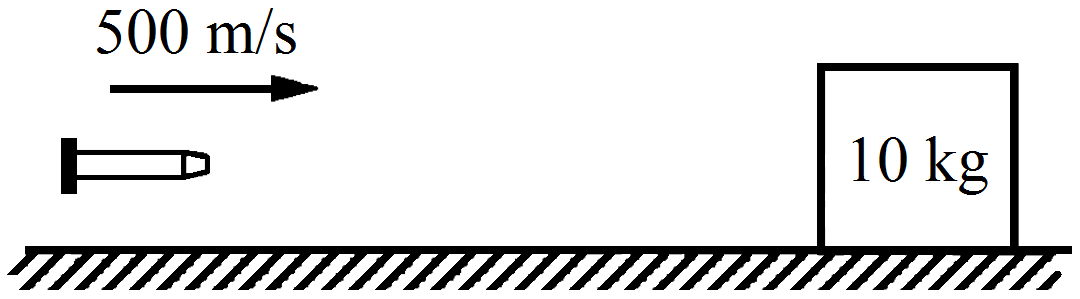
A bullet of mass 20g travelling horizontally with a speed of 500m/s passes through a wooden block of mass 10.0kg initially at rest on a level surface. The bullet emerges with a speed of 100m/s and the block slides 20cm on the surface before coming to rest. Find the friction coefficient between the block and the surface.

A person of mass 60kg wants to lose 5kg by going up and down a 10m high stairs. Assume he burns twice as much fat while going up than coming down. If 1kg of fat is burnt on expending 7000 kilo calories, how many times must he go up and down to reduce his weight by 5kg?
Write the effect of various factors on surface tension.
A helicopter of mass 1000kg rises with a vertical acceleration of 15ms-2. The crew and the passengers weigh 300kg. Give the magnitude and direction of the,
  1. Force on the floor by the crew and passengers.
  2. Action of the rotor of the helicopter on the surrounding air.
  3. Force on the helicopter due to the surrounding air.
An ideal gas is trapped between a mercury column and the closed-end of a narrow vertical tube of uniform base containing the column. The upper end of the tube is open to the atmosphere. The atmospheric pressure equals 76cm of mercury. The lengths of the mercury column and the trapped air column are 20cm and 43cm respectively. What will be the length of the air column when the tube is tilted slowly in a vertical plane through an angle of 60°? Assume the temperature to remain constant.
When a drop of mercury (radius R) is split into n similar drops, what is the change in surface energy?
[$\sigma-$surface tension of mercury]