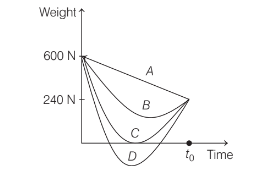
Read the passage given below and answer the following questions from 1 to 5. Satellites in a circular orbits around the earth in the equatorial plane with T = 24 hours are called Geostationary Satellites. Clearly, since the earth rotates with the same period, the satellite would appear fixed from any point on earth. It takes very powerful rockets to throw up a satellite to such large heights above the earth but this has been done in view of the several benefits of much practical application. Weight of an object is the force with which the earth attracts it. We are conscious of our own weight when we stand on a surface, since the surface exerts a force opposite to our weight to keep us at rest. The same principle holds good when we measure the weight of an object by a Spring balance hung from a fixed point e.g. the ceiling. The object would fall down unless it is subject to a force opposite to gravity. This is exactly what the spring exerts on the object. This is because the spring is pulled down a little by the gravitational pull of the object and in turn the spring exerts a force on the object vertically upwards. Now, imagine that the top end of the balance is no longer held fixed to the top ceiling of the room. Both ends of the spring as well as the object move with identical acceleration g. The spring is not stretched and does not exert any upward force on the object which is moving down with acceleration g due to gravity. The reading recorded in the spring balance is zero since the spring is not stretched at all. If the object were a human being, he or she will not feel his weight since there is no upward force on him. Thus, when an object is in free fall, it is weightless and this phenomenon is usually called the phenomenon of weightlessness. In a satellite around the earth, every part and parcel of the satellite has acceleration towards the centre of the earth which is exactly the value of earth’s acceleration due to gravity at that position. Thus in the satellite everything inside it is in a state of free fall. This is just as if we were falling towards the earth from a height. Thus, in a manned satellite, people inside experience no gravity. Gravity for us defines the vertical direction and thus for them there are no horizontal or vertical directions, all directions are the same.
- Astronaut experiences weightlessness in space because:
- Acceleration due to gravity is zero.
- Actual weight of astronaut is zero.
- They are going with same acceleration due to gravity.
- None of these.
- Weighing machine measures:
- Mass of the person.
- Normal reaction exerted by machine on person.
- Both a and b.
- None of these.
- What is geostationary satellite?
- What is weight? How it is measured?
- What is weightlessness astronaut in satellite experienced by ?