Question
The relation among u, v and f for a mirror is:

Answer

  1. $\text{f}=\frac{\text{uv}}{\text{u+v}}$
Explanation:
As we know,
$\frac{1}{\text{f}}=\frac{1}{\text{v}}+\frac{1}{\text{u}}$
$\frac{1}{\text{f}}=\frac{\text{u+v}}{\text{uv}}$
$\text{f}=\frac{\text{uv}}{\text{u+v}}$

Need a full question paper?

Generate a complete, print-ready paper with questions like this in minutes — across 16+ boards, with answer keys.
Start Generating Free

Similar questions

Which of the following waves have a maximum frequency?
In the Geiger-Marsden experiment, the force that scatters particles is:
While walking on ice, one should take small steps to avoid slipping. This is because smaller steps ensure:
  1. Larger friction.
  2. Smaller friction.
  3. Larger normal force.
  4. Smaller normal force.
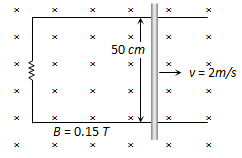
As shown in the figure a metal rod makes contact and complete the circuit. The circuit is perpendicular to the magnetic field with $B = 0.15$ tesla. If the resistance is $3Ω,$ force needed to move the rod as indicated with a constant speed of $2m/\sec$  is
The resistance of a metal wire increases with increasing temperature on account of:
How should people wearing spectacles work with a microscope(a) They cannot use the microscope at all (b) They should keep on wearing their spectacles(c) They should take off spectacles (d) (b) and (c) is both way 
   
   
The plate current $i_p$ in a triode valve is given $i_p=K\left(V_p+\mu V_g\right)^{3 / 2}$ where $i_p$ is in milliampere and $V_p$ and $V_g$ are in volt. If $r_p=10^4$ ohm, and $g_m=5 \times 10^{-3} \ mho$, then for ${ }^{i_p}=8 mA$ and $V_p=300$ volt, what is the value of K and grid cut off voltage
Which of the following is a wrong description of binding energy of a nucleus?
  1. It is the energy required to break a nucleus into its constituent nucleons.
  2. It is the energy made available when free nucleons combine to form a nucleus.
  3. It is the sum of the rest mass energies of its nucleons minus the rest mass energy of the nucleus.
  4. It is the sum of the kinetic energy of all the nucleons in the nucleus.
An $L-R$ circuit has a cell of $e.m.f. \ E,$ which is switched on at time $t=0.$ The current in the circuit after a long time will be
A sample contains $16\ gm$ of a radioactive material, the half life of which is two days. After $32$ days, the amount of radioactive material left in the sample is