MCQ
The relation between Faraday constant $(F)$, chemical equivalent $(E)$ and electrochemical equivalent $(Z)$ is
  • A
    $F = EZ$
  • B
    $F = \frac{Z}{E}$
  • $F = \frac{E}{Z}$
  • D
    $F = \frac{E}{Z^2}$

Answer

Correct option: C.
$F = \frac{E}{Z}$
c
The relation between Faraday constant chemical equivalent and electrochemical equivalent is $F =\frac{ E }{ Z }$

where $E$ is chemical equivalent, $Z$ is electrochemical equivalent and $F$ is faraday constant.

Need a full question paper?

Generate a complete, print-ready paper with questions like this in minutes — across 16+ boards, with answer keys.
Start Generating Free

Similar questions

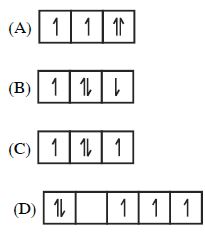
The portion of orbital diagrams representing the electronic configuration of certain elements shown below. Which of them violet Pauli’s Exclusion principle?
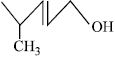
$IUPAC$ name of the below compound is :
Maximum number of spectral lines possible when an electron jumps from $5^{th}$ excited state to ground state in a sample containing only one Hydrogen atom will be
$N{H_4}Cl{O_{4\,}}\, + \,HN{O_3}(dil)\, \to \,HCl{O_4}\, + \,(X)\,\xrightarrow{\Delta }Y(g),$ $(X)$ and $(Y)$ are respectively
What is electronic arrangement of metal atom/ion in octahedral complex with $d^4$ configuration, if ${\Delta _0} < $ pairing energy.
Which of following is not correctly matched?
A. d-block element: electronic configuration is $n s^{0-2}(n-1) d^{1-10}$
B. p-block element: electronic configuration is $ns ^{1-2} np ^{1-6}$
C. s-block elemen: electronic configuration is $ns { }^{1-2}$
D. Ce: f-block's first member.
Consider th following four reactions:

$(I)$ $\begin{array}{*{20}{c}}
  {{C_6}{H_5} - CH - Cl} \\ 
  {\,\,|} \\ 
  {\,\,\,\,\,\,\,\,\,C{H_3}} 
\end{array}\xrightarrow[{5\% \,\,water}]{{95\% \,\,\,acetone}}\begin{array}{*{20}{c}}
  {{C_6}{H_5} - CH - OH} \\ 
  | \\ 
  {\,\,\,\,\,\,C{H_3}} 
\end{array}$

$(II)$ $\begin{array}{*{20}{c}}
  {{C_6}{H_5} - CH - Cl} \\ 
  {\,\,|} \\ 
  {\,\,\,\,\,\,C{H_3}} 
\end{array}\xrightarrow[{10\% \,\,water}]{{90\% \,\,\,acetone}}\begin{array}{*{20}{c}}
  {{C_6}{H_5} - CH - OH} \\ 
  | \\ 
  {\,\,\,\,\,\,C{H_3}} 
\end{array}$

$(III)$ $\begin{array}{*{20}{c}}
  {{C_6}{H_5} - CH - Cl} \\ 
  {\,\,|} \\ 
  {\,\,\,\,\,\,C{H_3}} 
\end{array}\xrightarrow[{20\% \,\,water}]{{80\% \,\,\,acetone}}\begin{array}{*{20}{c}}
  {{C_6}{H_5} - CH - OH} \\ 
  | \\ 
  {\,\,\,\,\,\,C{H_3}} 
\end{array}$

$(IV)$ $\begin{array}{*{20}{c}}
  {{C_6}{H_5} - CH - Cl} \\ 
  {\,\,|} \\ 
  {\,\,\,\,\,\,C{H_3}} 
\end{array}\xrightarrow{{100\% \,water}}\begin{array}{*{20}{c}}
  {{C_6}{H_5} - CH - OH} \\ 
  | \\ 
  {\,\,\,\,\,\,C{H_3}} 
\end{array}$

Arrange these reactions in decreasing order of greater proportion of inverted product and select correct answer from the codes given below :

Which of the following sign indicate that the sugar is actually ‘dextrorotatory’
$25\,g$ of a solute of molar mass $250\,g\,mol^{-1}$ is dissolved in $100\,ml$ of water to obtain a solution whose density is $1.25\,g\,ml^{-1}$. The molarity and molality of the solution are respectively
Which of the following pairs of elements might form an alloy