MCQ
The relation between $\gamma ,\,\eta $ and $K$ for a elastic material is
  • A
    $\frac{1}{\eta } = \frac{1}{{3\gamma }} + \frac{1}{{9K}}$
  • B
    $\frac{1}{K} = \frac{1}{{3\gamma }} + \frac{1}{{9\eta }}$
  • C
    $\frac{1}{\gamma } = \frac{1}{{3K}} + \frac{1}{{9\eta }}$
  • $\frac{1}{\gamma } = \frac{1}{{3\eta }} + \frac{1}{{9K}}$
Answer

Correct option: D.
$\frac{1}{\gamma } = \frac{1}{{3\eta }} + \frac{1}{{9K}}$
d
$\mu=$ Modulus of Rigiditg

$k =$ Bulk Modulus.

$\sigma=$ Normal stress

$y =3 k (1-2 \sigma)-(1)$

$y =2 \eta(1+\alpha)-(2)$

$\frac{ y }{3 k }=1-2 \sigma-(3), \frac{ x }{2 \mu}=1+\sigma-(4)$

Multiply eq $4$ by $2$.

$\frac{ y }{3 k }+\frac{ y }{\mu}=3-(5)$

Adding equ" $(3)$ and eqn $(5)$

$\frac{ y }{3 k }+\frac{ y }{\mu}=3$

$\frac{1}{3 k }+\frac{1}{\mu}=\frac{3}{ y }$

$\frac{1}{ y }=\frac{1}{9 k }+\frac{1}{3 \mu}$

Need a full question paper?

Generate a complete, print-ready paper with questions like this in minutes — across 16+ boards, with answer keys.

Start Generating Free

Similar questions

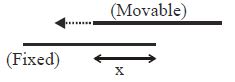
A parallel-plate capacitor consists of a fixed plate and a movable plate that is allowed to slide in the direction parallel to the plates. Let $x$ be the distance of overlap, as shown in the figure. The separation between the plates is fixed. Assume that the plates are electrically isolated, so that their charges $±Q$ are constant. Force on the movable plate is proportional to 
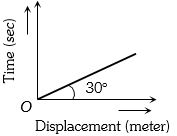
From the following displacement-time graph find out the velocity of a moving body
For a given triode $\mu = 20$. The load resistance is $1.5$ times the anode resistance. The maximum gain will be
A black coloured solid sphere of radius $R$ and mass $M$ is inside a cavity with vacuum inside. The walls of the cavity are maintained at temperature $T_0$. The initial temperature of the sphere is $3T_0$. If the specific heat of the material of the sphere varies as $\alpha T^3$ per unit mass with the temperature $T$ of the sphere, where $\alpha $ is a constant, then the time taken for the sphere to cool down to temperature $2T_0$ will be ( $\sigma $ is Stefan Boltzmann constant)
The activity of a radioactive sample is measured as $9750$ counts per minute at $t = 0$ and as $975$ counts per minute at $t = 5$ minutes. The decay constant is approximately ............ per minute
A point traversed half of the distance with a velocity $v_0$. The remaining part of the distance was covered with velocity $v_1$ for half the time and with velocity $v_2$ for the other half of the time. The mean velocity of the point averaged over the whole time of motion is
The moment of the force, $\overrightarrow {\;F} = 4\hat i + 5\hat j - 6\hat k$ at $(2, 0, -3),$ about the point $(2, -2, -2),$ is given by
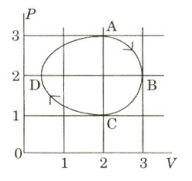
The figure shows the $P-V$ plot of an ideal gas taken through a cycle $ABCDA$. The part $ABC$ is a semi-circle and $CDA$ is half of an ellipse. Then,

$(A)$ the process during the path $\mathrm{A} \rightarrow \mathrm{B}$ is isothermal

$(B)$ heat flows out of the gas during the path $\mathrm{B} \rightarrow \mathrm{C} \rightarrow \mathrm{D}$

$(C)$ work done during the path $\mathrm{A} \rightarrow \mathrm{B} \rightarrow \mathrm{C}$ is zero

$(D)$ positive work is done by the gas in the cycle $ABCDA$

Critical angle of incidence for a pair of optical media is $45^{\circ}$. The refractive indices of first and second media are in the ratio:
A plane mirror is placed $22.5\; cm$ in front of a concave mirror of focal length $10\; cm$. an object can be placed between the two mirrors, so that the first image in both the mirrors by concave mirror. find out magnification of the image produced by concave mirror.