Question
The relation between $\lambda $ and $({T_{1/2}})$ is (${T_{1/2}}=$ half life, $\lambda=$ decay constant)

Answer

(b) Relation between half-life ( $T_{1 / 2}$ ) of a radioactive substancce and its decay constant $\lambda$ is $\lambda=\frac{\log _{e} 2}{T_{1 / 2}}$

Need a full question paper?

Generate a complete, print-ready paper with questions like this in minutes — across 16+ boards, with answer keys.
Start Generating Free

Similar questions

A car moves towards north at a speed of $54 \,km / h$ for $1 \,h$. Then it moves eastward with same speed for same duration. The average speed and velocity of car for complete journey is ..........
If $M_0$ is the mass of isotope ${ }_5^{12} B, M_p$ and $M_n$ are the masses of proton and neutron, then nuclear binding energy of isotope is:
Order of q/m ratio of proton, $\alpha $ -particle and electron is
A heating element has a resistance of  $100\,\Omega $ at room temperature. When it is connected to a supply of  $220\,V,$  a steady current of $2\,A$  passes in it and temperature is $500\,^oC$ more than room temperature. What is the temperature coefficient resistance of the heating element?
When the speed of electrons increases, then the value of its specific charge
Radius of the curved road on national highway is $R$. Width of the road is $b$. The outer edge of the road is raised by $h$ with respect to inner edge so that a car with velocity $v$ can pass safe over it. The value of $h$ is
A solid sphere of mass $M,$ radius $R$ and having moment of inertia about an axis passing through the centre of mass as $I$, is recast into a disc of thickness $t$, whose moment of inertia about an axis passing through its edge and perpendicular to its plane remains $I$. Then, radius of the disc will be
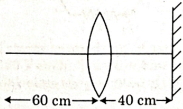
A point object is placed at a distance of $60\, \mathrm{~cm}$ from a convex lens of focal length $30 \,\mathrm{~cm}$. If a plane mirror were put perpendicular to the principal axis of the lens and at a distance of $40\, \mathrm{~cm}$ from it, the final image would be formed at a distance of :
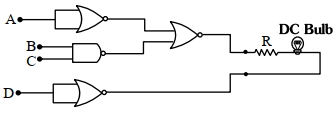
Following gates section is connected in a complete suitable circuit.

For which of the following combination, bulb will glow $(ON)$:
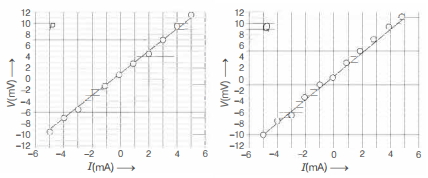
Two students $P$ and $Q$ perform an experiment to verify Ohm's law for a conductor with resistance $R$. They use a current source and a voltmeter with least counts of $0.1 mA$ and $0.1 \,mV$, respectively. The plots of the variation of voltage drop $V$ across $R$ with current $I$ for both are shown below. The statement which is most likely to be correct?