MCQ
The relation between phase difference  $ (\Delta \phi) $ and path difference $ (\Delta x) $ is
  • $\Delta \phi = \frac{{2\pi }}{\lambda }\Delta x$
  • B
    $\Delta \phi = 2\pi \lambda \Delta x$
  • C
    $\Delta \phi = \frac{{2\pi \lambda }}{{\Delta x}}$
  • D
    $\Delta \phi = \frac{{2\Delta x}}{\lambda }$
Answer

Correct option: A.
$\Delta \phi = \frac{{2\pi }}{\lambda }\Delta x$
a
(a)

Need a full question paper?

Generate a complete, print-ready paper with questions like this in minutes — across 16+ boards, with answer keys.

Start Generating Free

Similar questions

A person travelling on a straight line moves with a uniform velocity v1 for some time and with uniform velocity v2 for the next equal time. The average velocity is given by:

  1. $\text{v}=\frac{\text{v}_1+\text{v}_2}{2}$

  2. $\text{v}=\sqrt{\text{v}_1\text{v}_2}$

  3. $\frac{2}{\text{v}}=\frac{1}{\text{v}_1}+\frac{1}{\text{v}_2}$

  4. $\frac{1}{\text{v}}=\frac{1}{\text{v}_1}+\frac{1}{\text{v}_2}$

If the unit of force and length each be increased by four times, then the unit of energy is increased by.....$times$
A player throws a ball that reaches to the another player in $4\,s$. If the height of each player is $1.5\,m$, the maximum height attained by the ball from the ground level is  .......... $m$
If mass of a satellite is doubled and time period remain constant the ratio of orbit in the two cases will be
The law of conservation of energy means:
The velocity of sound in a gas at pressure $P$ and density $d$ is
There are two wire of same material and same length while the diameter of second wire is two times the diameter of first wire, then the ratio of extension produced in the wires by applying same load will be
The torque of force $\vec F =  - 2\hat i + 2\hat j + 3\hat k$ acting on a point $\vec r = \hat i - 2\hat j + \hat k$ about origin will be
A body takes $4\, {min}$. to cool from $61^{\circ} {C}$ to $59^{\circ} {C}$. If the temperature of the surroundings is $30^{\circ} {C}$, the time taken by the body to cool from $51^{\circ} {C}$ to $49^{\circ} {C}$ is $....\,min$
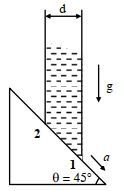
A cylindrical tube, with its base as shown in the figure, is filled with water. It is moving down with a constant acceleration $a$ along a fixed inclined plane with angle $\theta=45^{\circ} . P_1$ and $P_2$ are pressures at points 1 and 2 , respectively, located at the base of the tube. Let $\beta=\left(P_1-P_2\right) /(\rho g d)$, where $\rho$ is density of water, $d$ is the inner diameter of the tube and $g$ is the acceleration due to gravity. Which of the following statement($s$) is(are) correct?

$(A)$ $\beta=0$ when $a= g / \sqrt{2}$

$(B)$ $\beta>0$ when $a= g / \sqrt{2}$

$(C)$ $\beta=\frac{\sqrt{2}-1}{\sqrt{2}}$ when $a= g / 2$

$(D)$ $\beta=\frac{1}{\sqrt{2}}$ when $a= g / 2$