MCQ
The relation between the linear magnification $m,$ the object distance $u$ and the focal length $f$ is
  • A
    $m = \frac{{f - u}}{f}$
  • $m = \frac{f}{{f - u}}$
  • C
    $m = \frac{{f + u}}{f}$
  • D
    $m = \frac{f}{{f + u}}$

Answer

Correct option: B.
$m = \frac{f}{{f - u}}$
b
(b) $m =  - \frac{v}{u}$ also $\frac{1}{f} = \frac{1}{v} + \frac{1}{u}$

==> $\frac{u}{f} = \frac{u}{v} + 1$
==> $ - \frac{u}{v} = 1 - \frac{u}{f}$

$ \Rightarrow \frac{{ - v}}{u} = \frac{f}{{f - u}}$ so $m = \frac{f}{{f - u}}$.

Need a full question paper?

Generate a complete, print-ready paper with questions like this in minutes — across 16+ boards, with answer keys.
Start Generating Free

Similar questions

A wire of length $L$ and mass per unit length $6.0\times 10^{-3}\; \mathrm{kgm}^{-1}$ is put under tension of $540\; \mathrm{N}$. Two consecutive frequencies that it resonates at are : $420\; \mathrm{Hz}$ and $490 \;\mathrm{Hz}$. Then $\mathrm{L}$ in meters is
The rotation period of an earth satellite close to the surface of the earth is $83$ minutes. The time period of another earth satellite in an orbit at a distance of three earth radii from its surface will be .......... $\min$
If a block moving up an inclined plane at $30^{\circ}$ with a velocity of $5 \,m / s$, stops after $0.5 s$, then coefficient of friction will be nearly
One mole of an ideal gas expands at a constant temperature of $300 \,K$ from an initial volume of $10\, litres$ to a final volume of $20\, litres$. The work done in expanding the gas is ...... $J.$ $(R = 8.31 J/mole-K)$
The latent heat of vaporization of a substance is always
A cubical block is floating in a liquid with one fourth of its volume immersed in the liquid. If whole of the system accelerates upward with acceleration $g / 4$, the fraction of volume immersed in the liquid will be ..........
If the separation between slits in Young’s double slit experiment is reduced to $\frac{1}{3}rd,$ the fringe width becomes $n$ times. The value of $n$ is
If element with principal quantum number $n > 4$ were not allowed in nature, then the number of possible elements would be
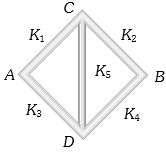
Five rods of same dimensions are arranged as shown in the figure. They have thermal conductivities $K1, K2, K3, K4$ and $K5$ . When points $A$ and $B$ are maintained at different temperatures, no heat flows through the central rod if
A nucleus of atomic mass $A$ and atomic number $Z$ emits ${M_1}$ particles. The atomic mass and atomic number of the resulting nucleus are