Question
The relation between the linear magnification $m,$ the object distance $u$ and the focal length $f$ is

Answer

(b) $m =  - \frac{v}{u}$ also $\frac{1}{f} = \frac{1}{v} + \frac{1}{u}$

==> $\frac{u}{f} = \frac{u}{v} + 1$
==> $ - \frac{u}{v} = 1 - \frac{u}{f}$

$ \Rightarrow \frac{{ - v}}{u} = \frac{f}{{f - u}}$ so $m = \frac{f}{{f - u}}$.

Need a full question paper?

Generate a complete, print-ready paper with questions like this in minutes — across 16+ boards, with answer keys.
Start Generating Free

Similar questions

The total energy of particle performing $S.H.M.$ depend on
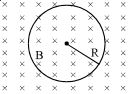
$a$ conducting loop of radius $R$ is present in a uniform magnetic field $B$ perpendicular the plane of the ring. If radius $R$ varies as a function of time $‘t’$, as $R = R_0+ t$. The $e.m.f$ induced in the loop is
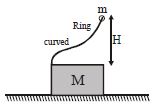
A ring of mass $m$ can freely slide along the massless curved rod as shown. At the lower most point, the curved path becomes vertical. If whole system is released from rest, velocity of ring $(v) $ at lowermost point just before touching the block $M$ (all surfaces are smooth) is
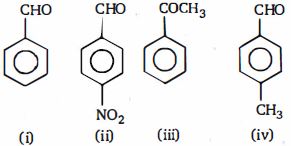
Arrange the following carbonyl compounds in decreasing order of their reactivity in nucleophilic addition reaciton.
Radiation from a black body at the thermodynamic temperature $T_1$ is measured by a small detector at distance $d_1$ from it. When the temperature is increased to $T_2$ and the distance to $d_2$ , the power received by the detector is unchanged . What is the ratio $d_2/d_1$ ?
At ordinary temperatures, the electrical conductivity of semi conductors in $mho/mete{\rm{r}}$ is in the range
A particle of mass $10\, g$ is kept of the surface of a uniform sphere of mass $100\, kg$ and a radius of $10\, cm .$ Find the work to be done against the gravitational force between them to take the particle far away from the sphere. (you make take $\left.G=6.67 \times 10^{-11} Nm ^{2} / kg ^{2}\right)$
An engine pumps water through a hose pipe. Water passes through the pipe and leaves it with a velocity of $2\, m/s$. The mass per unit length of water in the pipe is $100\, kg/m.$ What is the power of the engine $?$ ................ $\mathrm{W}$
The potential energy of a $1\ kg$ particle free to move along the $x-$axis is given by : $U\left( x \right) = \left( {\frac{{{x^4}}}{4} - \frac{{{x^2}}}{2}} \right)$ $J $ The total mechanical energy of the particle is $2\ J$. Then, the maximum speed(in $m/s$) is
The phase difference between the voltage and the current in an ac circuit is $\pi /4$. If the frequency is $50\, Hz$ then this phase difference will be equivalent to a time of