MCQ
The relation between the linear magnification $m,$ the object distance $u$ and the focal length $f$ is
  • A
    $m = \frac{{f - u}}{f}$
  • $m = \frac{f}{{f - u}}$
  • C
    $m = \frac{{f + u}}{f}$
  • D
    $m = \frac{f}{{f + u}}$

Answer

Correct option: B.
$m = \frac{f}{{f - u}}$
b
(b) $m =  - \frac{v}{u}$ also $\frac{1}{f} = \frac{1}{v} + \frac{1}{u}$

==> $\frac{u}{f} = \frac{u}{v} + 1$
==> $ - \frac{u}{v} = 1 - \frac{u}{f}$

$ \Rightarrow \frac{{ - v}}{u} = \frac{f}{{f - u}}$ so $m = \frac{f}{{f - u}}$.

Need a full question paper?

Generate a complete, print-ready paper with questions like this in minutes — across 16+ boards, with answer keys.
Start Generating Free

Similar questions

The number of revolutions per second made by an electron in the first Bohr orbit of hydrogen atom is of the order of
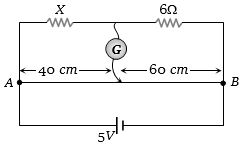
In the circuit shown, a meter bridge is in its balanced state. The meter bridge wire has a resistance $0.1\, ohm/cm$. The value of unknown resistance $X$ and the current drawn from the battery of negligible resistance is
In Heinrich Hertz’s experiment on the production of electromagnetic waves by means of spark discharge, it was observed that high voltage sparks across the detector loop were $........$ when the emitter plate was illuminated by $........$ light?
Two toroids $1$ and $2$ have total number of tums $200$ and $100 $ respectively with average radii $40\; \mathrm{cm}$ and $20 \;\mathrm{cm}$ respectively. If they carry same current $i,$ the ratio of the magnetic flelds along the two loops is
If the focal length of objective and eye lens are 1.2 cm and 3 cm respectively and the object is put 1.25 cm away from the objective lens and the final image is formed at infinity. The magnifying power of the microscope is
Identify the factor on which the capacitance of a parallel plate capacitor does not depend.
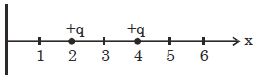
Two charged particles, each with a charge of $+q$, are located along the $x$ -axis at $x = 2$ and $x = 4$, as shown below. Which of the following shows the graph of the magnitude of the electric field along the $x$ -axis from the origin to $x = 6$?
When a wire of uniform cross-section a, length l and resistance R is bent into a complete circle, resistance between any two of diametrically opposite points will be
The theory of quantisation of electric charge was given by:
Second law of Kirchhoff depends on the principle of conservation of: