MCQ
The-relation between the magnetic susceptibility and the magnetic permeability is
  • A
    $x = \mu  -1$
  • $x = \mu_r -1$
  • C
    $x = \mu + 1$
  • D
    $x = \mu _r + 1$

Answer

Correct option: B.
$x = \mu_r -1$
b

Need a full question paper?

Generate a complete, print-ready paper with questions like this in minutes — across 16+ boards, with answer keys.
Start Generating Free

Similar questions

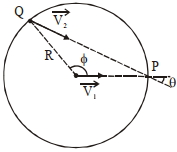
Two particles, one at the centre of a circle of radius $R$, and another at a point $Q$ on the circle, start moving towards a point $P$ on the circle at the same time (see figure below). Both are at rest initially and move with uniform velocities $\vec{V}_1$ and $\overrightarrow{V_2}$ respectively. They also reach the point $P$ at the same time, If the angle between the velocities is $\theta$ and the angle subtended by $P$ and $Q$ at the centre is $\phi$ (as shown in the figure), then
A mass $M$ is suspended from a light spring. An additional mass m added displaces the spring further by a distance $x$. Now the combined mass will oscillate on the spring with period
For ordinary terrestrial experiments, which of the following observers below are inertial.
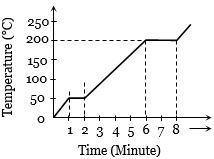
A student takes $50\,gm$ wax $($specific heat $= 0.6\, kcal/kg°C)$ and heats it till it boils. The graph between temperature and time is as follows. Heat supplied to the wax per minute and boiling point are respectively
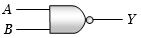
Which gates is represented by this figure
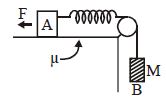
Block $A$ of mass $m$ and block $B$ of mass $M$ are connected by a massless spring over a pulley on a rough plane with coefficient of friction as $μ$. A force $F$ is applied on block $A$ to the left. Find the minimum value of $M$ to move the block $A$ towards right
$\begin{matrix}
   O\,\,\,\,\,\,\,\,\,  \\
   ||\,\,\,\,\,\,\,\,\,\,  \\
   C{{H}_{3}}C{{H}_{2}}-C-C{{H}_{3}}\xrightarrow[HCl]{NaN{{O}_{2}}};  \\
\end{matrix}$ Major product of this reaction is
To establish an instantaneous current of $2\,A$ through a $1\,\mu F$ capacitor ; the potential difference across the capacitor plates should be changed at the rate of
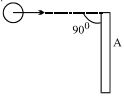
$A$ thin rod of mass $M$ and length $L$ is struck at one end by a ball of clay of mass $m$, moving with speed $v$ as shown in figure. The ball sticks to the rod. After the collision, the angular momentum of the clay-rod system about $A$, the midpoint of the rod, is 
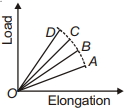
The load versus elongation graph for four wires of same length and the same material is shown in figure. The thinnest wire is represented by line