MCQ
The relationship between Young's modulus $Y,$ Bulk modulus $K$ and modulus of rigidity $\eta $ is
  • $Y = \frac{{9\eta K}}{{\eta + 3K}}$
  • B
    $\eta = \frac{{9YK}}{{Y + 3K}}$
  • C
    $Y = \frac{{9\eta K}}{{3 + K}}$
  • D
    $Y = \frac{{3\eta K}}{{9\eta + K}}$

Answer

Correct option: A.
$Y = \frac{{9\eta K}}{{\eta + 3K}}$
a
(a)$Y = 3K(1 - 2\sigma ){\rm{ and}}\;Y = 2\eta (1 + \sigma )$

Eliminating $\sigma $ we get $Y = \frac{{9\eta K}}{{\eta + 3K}}$

Need a full question paper?

Generate a complete, print-ready paper with questions like this in minutes — across 16+ boards, with answer keys.
Start Generating Free

Similar questions

If all matters were made of electrically neutral particles such as neutrons:
  1. There would be no force of friction.
  2. There would be no tension in the string.
  3. It would not be possible to sit on a chair.
  4. The earth could not move around the sun.
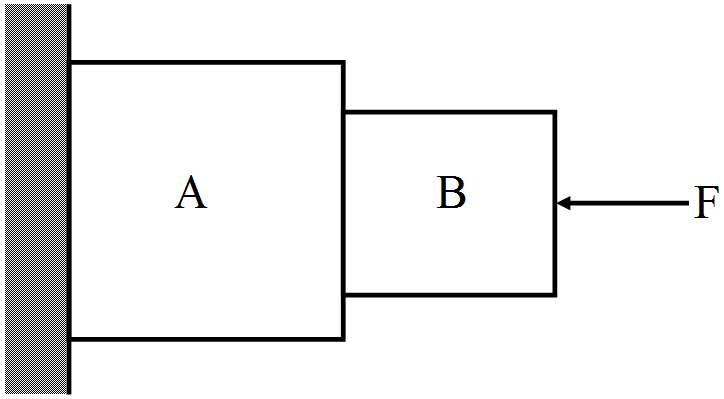
Consider the situation shown in figure. The wall smooth but the surface of A and B in contact are rough. The friction on B due to A in equilibrium:

  1. Is upward.
  2. Is downward.
  3. Is zero.
  4. The system cannot remain in equilibrium.
If at same temperature and pressure, the densities for two diatomic gases are respectively ${d_1}$ and ${d_2}$, then the ratio of velocities of sound in these gases will be
A particle moves from position $3\hat i + 2\hat j - 6\hat k$ to $14\hat i + 13\hat j + 9\hat k$ due to a uniform force of $(4\hat i + \hat j + 3\hat k)\,N.$ If the displacement in meters then work done will be.........$J$
Can the centre of gravity be situated outside the material of the body?
A body starts from rest from a point distance $R_0$ from the centre of the earth. The velocity acquired by the body when it reaches the surface of the earth will be ($R$ represents radius of the earth).
The initial pressure and volume of an ideal gas are $P_0$ and $V_0$. The final pressure of the gas when the gas is suddenly compressed to volume $\frac{ V _0}{4}$ will be (Given $\gamma=$ ratio of specific heats at constant pressure and at constant volume)
If a liquid is heated in weightlessness, the heat is transmitted through
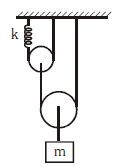
What is the period of small oscillations of the block of mass $m$ if the springs are ideal and pulleys are massless ?
The two thigh bones (femures), each of cross-sectional area $10 \,cm ^2$ support the upper part of a person of mass $50 \,kg$. The average pressure sustained by the femures is ............. $N / m ^2$