The relative reactivities of acyl compounds towards nucleophbstitution are in the order of
AIIMS 2018, Medium



Download our appand get started for free
Experience the future of education. Simply download our apps or reach out to us for more information. Let's shape the future of learning together!No signup needed.*
Similar Questions
- 1View SolutionThe final product of the given sequence is :
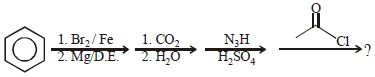
- 2A compound $X $ on reaction with chloroform and $NaOH$ gives a compound with a very unpleasant odour. $X$ isView Solution
- 3View SolutionIn which of the following primary amine is not obtained as a product
- 4Deamination (or) diazotization of $n-Bu-NH_2$ with $NaNO_2/HCl$ gives ......... isomeric butene.View Solution
- 5View SolutionThe action of nitrous acid on ethyl amine gives
- 6View SolutionWhich of the following is the strongest base?
- 7Major product $(R)$ of following reaction is :View Solution
Figure $\xrightarrow[{pyridine}]{{C{H_3}COCl}}$ $P$ $\xrightarrow[{C{H_3}COOH}]{{B{r_2}}}Q\,\xrightarrow{{{H_3}{O^ + }}}R$

- 8$9.3 \mathrm{~g}$ of aniline is subjected to reaction with excess of acetic anhydride to prepare acetanilide. The mass of acetanilide produced if the reaction is _________$100 \%$ completed is $\times 10^{-1} \mathrm{~g}$. (Given molar mass in $\mathrm{g} \mathrm{mol}^{-1} \mathrm{~N}: 14, \mathrm{O}: 16, \mathrm{C}$ : $12, \mathrm{H}: 1)$View Solution
- 9The end product of the reactions isView Solution
${{C}_{2}}{{H}_{5}}N{{H}_{2}} \xrightarrow{HN{{O}_{2}}}A \xrightarrow{PC{{l}_{5}}}B \xrightarrow{H.N{{H}_{2}}}C$
- 10Methyl amine on reaction with chlorine in the presence of $NaOH$ gives :View Solution